The disappointing performance of small cap equities is a recurring theme in nearly every market discussion. Small cap stocks have badly underperformed large caps since the benchmark Russell 2000® Index peaked in 2021, so they make an easy punching bag.

But are the criticisms leveled against small caps justified, or even relevant, in today’s market? Here, we will attempt to dispel the negative perceptions that have sprung up around the asset class by addressing a few important questions.

The Quality Question

A common reproach of small cap stocks is that they are of generally poor quality—as measured by the strength and long-term consistency of revenue and profit growth-- especially compared to large cap stocks. Hasn’t it always held true that smaller companies were lower in quality than their larger competitors? Their earnings are more tenuous and cyclical, and their balance sheets carry a greater debt load. By one popular measure of quality–profit margins (shown below, based on data from Furey Research)– small cap margins have been below those of large caps for nearly 40 years. 

Figure 1. Small Cap Margins Have Historically Trailed Those of Larger Counterparts

Trailing 12-month net profit margins on indicated indexes, December 1987–June 2025

Line Chart Showing Trailing 12-month net profit margins on indicated indexes, December 1987–June 2025
Source: Furey Research and FactSet. Data as of June 30, 2025. LTM = Last (trailing) 12 months. R2000 = Russell 2000® Index.
Past performance is not a reliable indicator or guarantee of future results. The historical data shown in the chart above are for illustrative purposes only and do not represent any specific portfolio managed by Lord Abbett. Indexes are unmanaged, do not reflect the deduction of fees or expenses, and are not available for direct investment.

But “high quality” is not the only factor that drives stocks higher.  Consider a real-world example: In 1970, IBM was one of the highest-quality companies in the world. It was the dominant force in computing, with higher growth and profit margins than most other industrial peers and, at $45 billion market capitalization, it was among the most valuable companies in the United States. But that legacy did not translate to a strong stock performance. In fact, the closing price of IBM at the end of 1993, at $14.13, was below its closing price at the end of 1970, $15.89. That’s 23 years without share price appreciation.

The point is stocks outperform for many reasons, including the quality of the business, but also the compounding effects of their earnings growth, the outlook for their business prospects in future periods, and investor sentiment towards the shares, among other inputs. So yes, it is true that small caps are lower quality than large caps, and yes, it is true that small caps have underperformed large caps but, remember that there are other factors affecting share price performance. In the case of quality, correlation may not be causation.

The IPO Question

Another frequent criticism of small caps is that “companies are staying private for longer, and the best companies do not come public.” In other words, the pool of desirable investment candidates in the small cap universe is not growing. Undoubtedly there is a secular trend in fewer companies staging initial public offerings (IPOs) over the last 20 years.

However, it is important to consider the cyclical elements of the IPO market. The same argument was made in the years after the global financial crisis of 2008–09. At that time, the name that was most often mentioned as the “great private company that hasn’t done an IPO” was Facebook (now Meta). Years earlier, similar chatter occurred after the Internet bubble burst, only around a different name–Google (now Alphabet). Ultimately, both companies did come public once the public markets became more amenable to IPOs: Google in late 2004 and Facebook in mid-2012. Google debuted about two years after the bear market bottom in 2002, and Facebook went public four years after the bear market bottom in 2008.

Companies have to be careful in considering the environment for new equity issues, as there is good reason for the IPO market to stay closed for two-to-four years after a market bottom. Namely, valuation, since capital flows to where it is treated best. Until the bear market losses are recovered, and prices stabilize, most private companies are worth more than what the public markets would value them at. This means that a company with an IPO soon after a bear market bottom may have to accept a valuation below its last round of private financing. This is a tough pill to swallow, and it can often have knock-on effects, as other private companies may need to accept lower valuations in their next private rounds.

Once those dynamics change, however, companies are much more likely to go launch an initial offering. This is happening right now in public markets. In the past 18 months, three highly anticipated small cap IPOs–Reddit, Astera Labs and Circle Internet Group–have all come public. Their public market valuations are four to six times what they were as private companies. Now, more companies are accelerating plans for their own IPOs. Again, capital is flowing to where it is treated best. 

Figure 2. A Scorecard of Recent High-Profile Small Cap IPOs

Chart Featuring A Scorecard of Recent High-Profile Small Cap IPOs
Source: Bloomberg. Data as of September 30, 2025.
Past performance is not a reliable indicator or guarantee of future results. The historical data shown in the chart above are for illustrative purposes only and do not represent any specific portfolio managed by Lord Abbett. Mentions of specific companies are for reference purposes only and are not meant to describe the investment merits of, or potential or actual portfolio changes related to, securities of those companies.

Additionally, it is also important to contextualize today’s private companies. It is not unprecedented for large companies to stay private if they can continue to attract private capital. Google came public in 2004 at a valuation of approximately $25 billion, which was approximately one-twelfth of the most valuable company in the world at the time, General Electric. At the time of its IPO, Facebook earned a $100 billion dollar valuation, making it worth one-fifth of the most valuable company in the world at that time, Apple. Interestingly, Open AI, which is the most valuable private company in the world today, is valued at around $500 billion, making it worth one-ninth of the most valuable company in the world, Nvidia. Still, including these outliers, over the last 30 years (including each of the last four years) 90% of the IPOs open at a valuation within the range of the Russell 2000 small cap index.

The Earnings Question

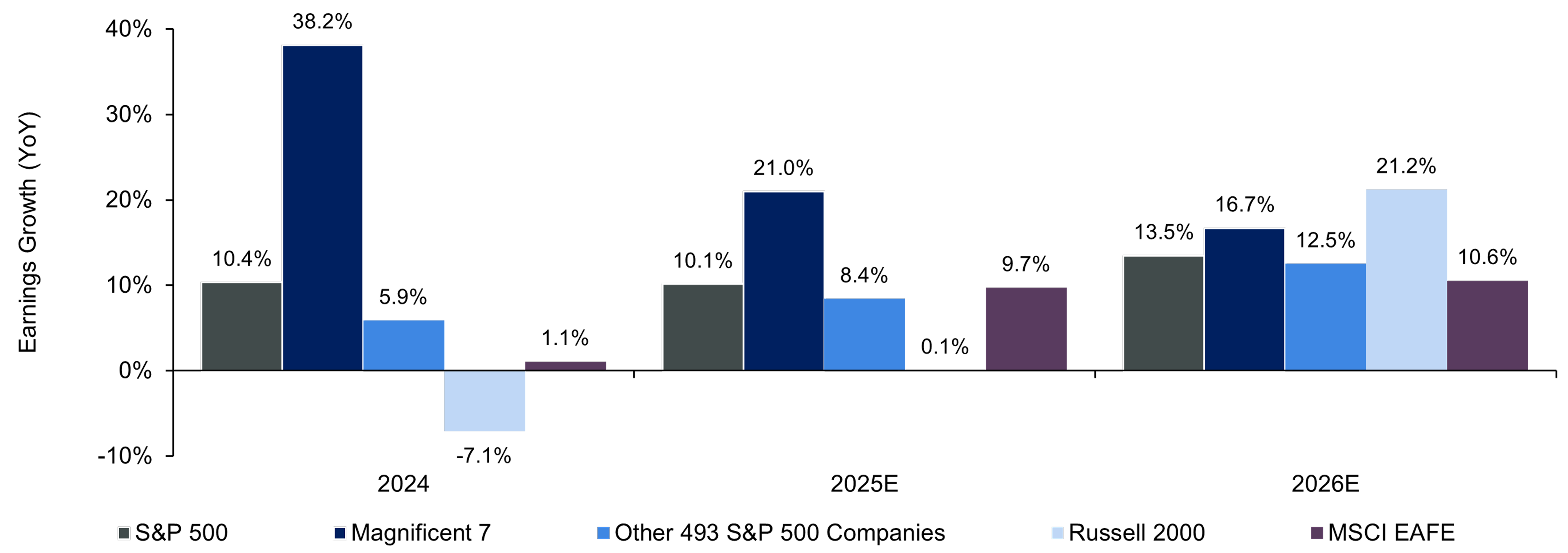
Finally, when analyzing companies of all sizes, it is essential to follow the earnings. In March 2021, the relative performance of small caps peaked, and the trailing five-year performance of small caps outpaced large caps. That came on the heels of explosive earnings growth in the second half of 2020. Since then, small cap earnings have stumbled, lagging larger companies and mega-caps over the last four years. That looks likely to change. Indeed, it’s started already: Earnings growth for small cap stocks has narrowed the gap versus large cap companies so far in 2025. Accelerating earnings growth could be the catalyst for further share price appreciation. 

Figure 3. Earnings Gap Narrowing Between Mega Caps and the Broader Market

Year-over-year earnings growth for indicated indexes

Bar Chart Showing Year-over-year earnings growth for indicated indexes
Source: FactSet and Bloomberg. Data as of September 30, 2025. E=estimated. “Magnificent 7” refers to mega-cap companies NVIDIA, Meta, Tesla, Amazon, Alphabet, Apple, and Microsoft, all of which are in the S&P 500. Earnings growth measured by growth in net income.
Past performance is not a reliable indicator or guarantee of future results. The historical data shown in the chart above are for illustrative purposes only and do not represent any specific portfolio managed by Lord Abbett.

A Final Word

Be skeptical when you hear the narrative that small caps are damaged goods; cyclical factors and recency biases are often at play. We think thoughtful portfolio allocation should include small cap and mid cap stocks, perhaps now more than ever. In every market capitalization, both in the United States and abroad, active managers with advanced research capabilities and disciplined security selection processes have the potential to identify alpha opportunities. Given that potential, and the supporting factors we’ve identified here, perhaps all the nagging questions about small caps can finally be put to rest.