Higher Interest Rates: What Equity Investors Should Know

Healthy economic growth, strong corporate earnings, and expanding global investment opportunities could continue to support the case for active equity investing.

Rising Rates Have Not Historically Prevented Positive Equity Returns

While higher interest rates can create volatility, their impact on equity performance has historically been less straightforward than investors might expect.
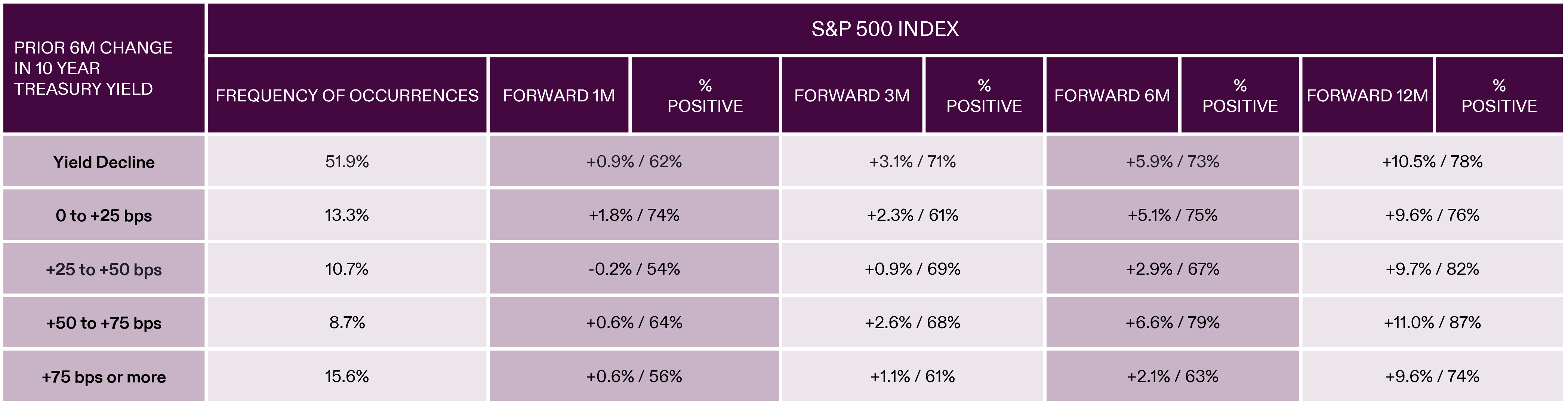
An analysis of nearly 50 years of market data shows that the S&P 500 Index generated positive average 12-month forward returns across every category of changes in the 10-year Treasury yield, including periods when rates increased sharply (see Figure 1). When the 10-year Treasury yield rose between 50 and 75 basis points over six months, the S&P 500 subsequently generated an average 12-month return of 11%, with positive returns in 87% of observations. Even when Treasury yields increased by more than 75 basis points, the index delivered an average forward return of 9.6%, with positive returns in 74% of observations.
 

Figure 1. Equity Markets Have Historically Experienced Positive Returns Across Rate Environments

Changes in the 10-year U.S. Treasury Yield versus the S&P 500 average forward return and the percentage of periods with positive returns, January 1, 1976-September 30, 2026

Table illustrating S&P 500 forward returns after changes in the 10-Year Treasury yield. Regardless of whether yields fell or rose, average 12-month S&P 500 returns remained positive, ranging from 9.6% to 11.0%, with positive outcomes in most periods.

Source: Bloomberg and Lord Abbett. Data as of September 30, 2026. For illustrative purposes only and does not represent any specific portfolio managed by Lord Abbett or any particular investment. Past performance is not a reliable indicator or guarantee of future results. Indexes are unmanaged, do not reflect the deduction of fees or expenses, and are not available for direct investment.

These results do not suggest that interest rates are unimportant. Rather, they suggest that changes in rates alone have not consistently determined equity market performance. Earnings growth, valuations, and the underlying economic environment also influence returns.

Higher Rates, Stronger Earnings, Lower Multiples

While interest rates have risen, resilient economic activity and healthy business fundamentals have supported corporate earnings growth. Treasury yields reflect a combination of economic growth, inflation expectations, and other factors, but for equity investors, what matters most is what drives changes in interest rates and how those changes affect corporate earnings.

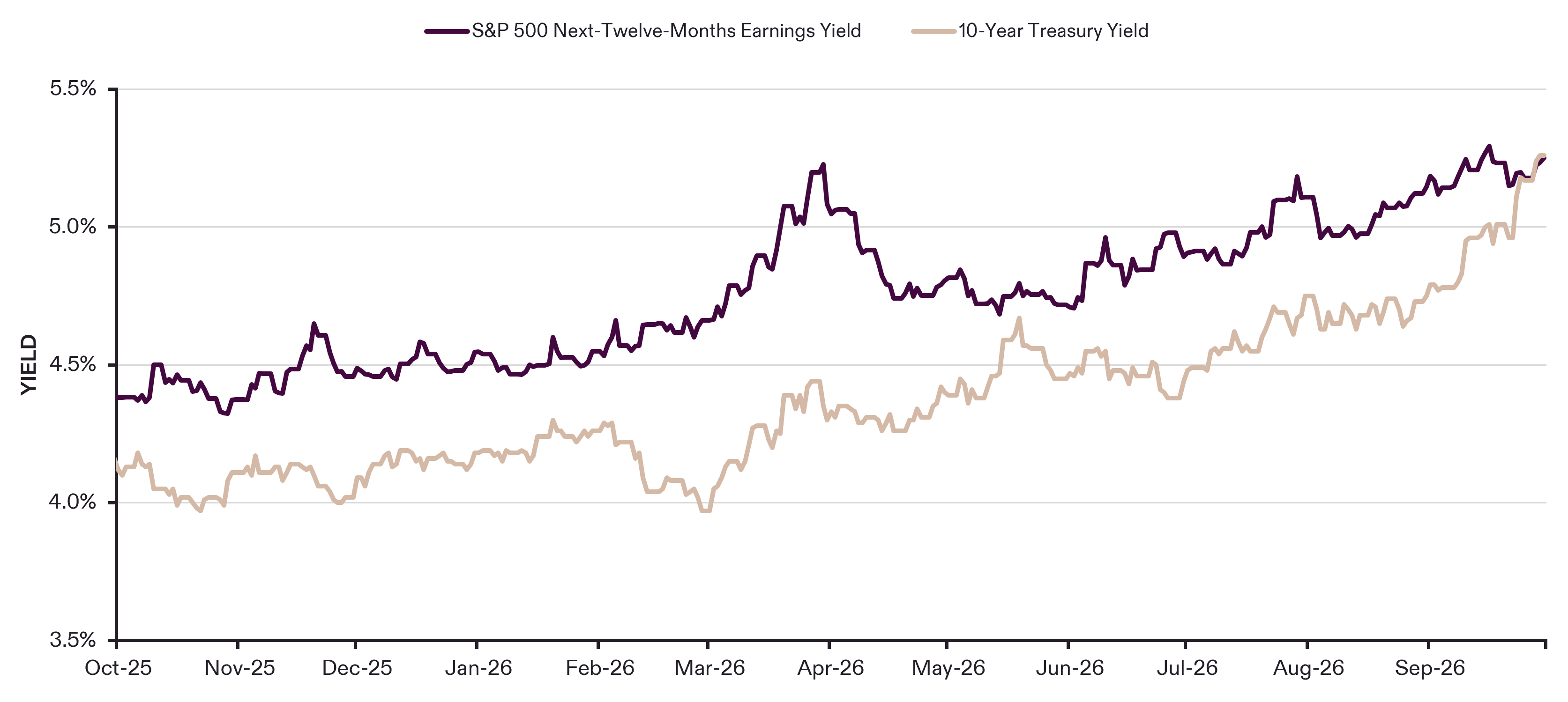
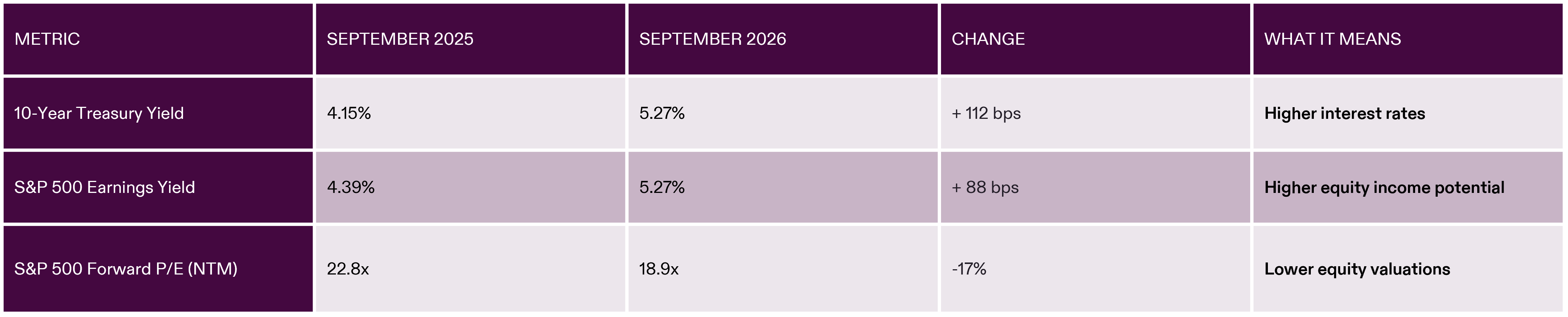
In the U.S., nominal GDP growth has exceeded 6%, according to the U.S. Bureau of Economic Analysis as of June 30, 2026. This could continue to provide a favorable backdrop for corporate profit growth. Despite concerns about elevated equity valuations a year ago, the S&P 500 Index subsequently gained over 15.7% on a total return basis, according to Bloomberg, for the 12 months ended September 30, 2026. That performance has been accompanied by a decline in the market's price-to-earnings (P/E) multiple, according to FactSet as of September 30, 2026, as earnings growth has outpaced share-price appreciation. The S&P 500 earnings yield also increased from approximately 4.4% to 5.3%, while the 10-year Treasury yield rose from 4.2% to 5.3% (see Figure 2). The increase in earnings yield reflects lower valuation multiples, even as corporate profits have continued to grow.
 

Figure 2. Earnings Growth Has Held Up Despite Higher Rates, Making Equity Valuations More Attractive

S&P 500 Index earnings yield and U.S. 10-year Treasury yield, October 31, 2025-September 30, 2026

Double line chart showing the S&P 500 earnings yield and 10-Year Treasury yield rising from October 2025 through September 2026, with the earnings yield remaining slightly higher for most of the period before both converge near 5.2% by September 2026.
Table showing changes in market metrics from September 2025 to September 2026: 10-Year Treasury Yield rose to 5.27%, S&P 500 Earnings Yield rose to 5.27%, and S&P 500 Forward P/E fell to 18.9x, reflecting higher interest rates, higher equity income potential, and lower equity valuations.

Source: FactSet and Federal Reserve Bank of St. Louis. Data as of September 30, 2026. Earnings yield is a measure of a company's or stock index's earnings relative to its market price, expressed as a percentage. It is calculated by dividing earnings per share by the stock price and is the inverse of the price-to-earnings (P/E) ratio. A higher earnings yield generally indicates a lower valuation relative to earnings. For illustrative purposes only and does not represent any specific portfolio managed by Lord Abbett or any particular investment. Past performance is not a reliable indicator or guarantee of future results. Indexes are unmanaged, do not reflect the deduction of fees or expenses, and are not available for direct investment.

A similar dynamic has unfolded internationally. Interest rates have risen from historically low levels in Europe and Japan, reflecting both inflation and more resilient economic growth. Yet international equities have continued to perform well, with the MSCI World Index gaining approximately 15.7% over the preceding 12 months ended September 30, 2026, on a net return basis, according to Bloomberg.

The important distinction is that higher rates do not necessarily signal deteriorating conditions for equities. When rates rise alongside healthy economic and earnings growth, corporate fundamentals can help offset pressure on valuations.

Interest Rate Volatility Helps to Create Different Outcomes Across Businesses

The effect of higher interest rates is not uniform across the equity market. Some industries face pressure from higher financing costs, while others benefit from changes in rates or increased market activity. Rate-sensitive sectors such as real estate investment trusts (REITs) and utilities can face challenges because of their capital requirements and sensitivity to financing costs. Conversely, banks as a sector may benefit from higher interest rates, particularly through improved lending margins. This may be especially relevant in markets such as Europe and Japan, where interest rates are normalizing after prolonged periods of exceptionally low or negative rates.

Interest-rate volatility can also affect businesses differently within the same sector. Financial exchanges, for example, may benefit from greater demand for hedging and risk-management products, while credit-rating agencies can face headwinds when volatile rates discourage debt issuance. These differences reinforce the importance of evaluating individual business models rather than making broad investment decisions based on interest-rate forecasts across markets.

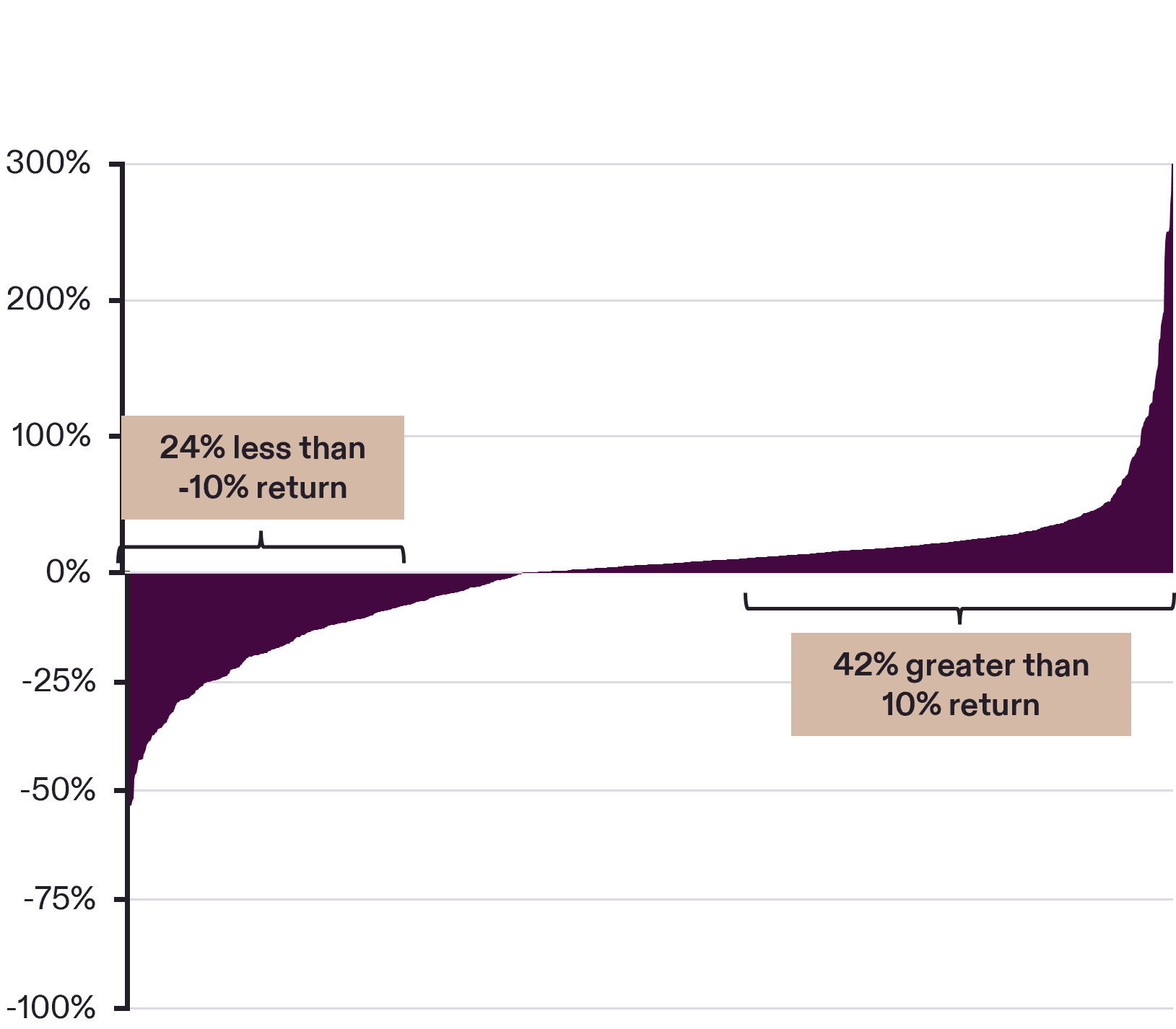
The wide dispersion in individual stock returns in 2026 also reinforces the case for active security selection. As of September 30, 2026, 42% of securities in the MSCI World Index had generated year-to-date returns greater than 10%, while 24% had declined by more than 10% (see Figure 3). This significant gap in performance highlights the opportunities for active managers to distinguish companies with strong fundamentals from those facing greater challenges, including higher interest rates.
 

Figure 3. Dispersion Favors an Active Approach to Equities

MSCI World Index year-to-date security level returns, January 1, 2026-September 30, 2026

Return distribution chart showing that 24% of outcomes were below -10% and 42% were above 10%, with returns ranging from roughly -100% to +300%

Source: FactSet. Data as of September 30, 2026. Past performance is not a reliable indicator or guarantee of future results. Indexes are unmanaged, do not reflect the deduction of fees or expenses, and are not available for direct investment.

A Companies, Not Countries Approach

The wide dispersion in stock returns reinforces the importance of active, bottom-up security selection, in our view. Seeking companies with sustainable competitive advantages can help distinguish businesses positioned to sustain earnings growth from those more vulnerable to higher costs and competitive pressures.

We believe three broad sources of competitive advantage are particularly relevant:

Consumer advantage: Companies with differentiated products, strong brands, or customer relationships that support pricing power.

Producer advantage: Businesses with scale, specialized processes, or operating efficiencies that competitors may find difficult to replicate.

Network advantage: Companies whose products or services become more valuable as their networks of customers, users, or participants expand.

These business strengths can help companies sustain attractive returns on capital, reinvest in their businesses, and maintain earnings growth even as economic conditions change.

Structural Growth Trends Help to Broaden Equity Opportunities

Several long-term investment trends continue to help support corporate earnings growth across global markets. AI remains a significant driver of capital spending and innovation. While much of the infrastructure investment is currently concentrated in the U.S., companies around the world may participate in the supply chain, including semiconductor equipment manufacturers and other technology providers.

The opportunity is also expanding beyond infrastructure into companies adopting AI to improve productivity, customer experiences, and business operations. Applications range from software development and digital marketplaces to more sophisticated automation and transaction processing. Other structural trends include electrification and power-grid modernization, which could support a multiyear capital investment cycle. Increased defense spending in Europe and Asia is also helping to create demand for specialized industrial and technology companies. Energy infrastructure is another area of interest, particularly as global demand for reliable energy supplies supports investment in North American pipelines and liquefied natural gas export facilities.

These trends are helping broaden earnings opportunities beyond the largest U.S. technology companies. They also provide support for international markets, where stronger structural growth drivers may contribute to a more sustained earnings cycle.

Summing Up

Higher interest rates have pressured equity valuations, but resilient economic growth and strong corporate earnings continue to support global equity markets. Historical evidence also shows that rising Treasury yields have not consistently prevented positive equity returns.

The impact of higher rates varies across sectors and business models, while structural investment trends are helping to create opportunities across global markets. For long-term investors, the focus should remain on seeking companies with sustainable competitive advantages, pricing power, and the ability to generate attractive returns on capital. A disciplined, bottom-up approach can help capture those opportunities without relying on predictions about the direction of interest rates.