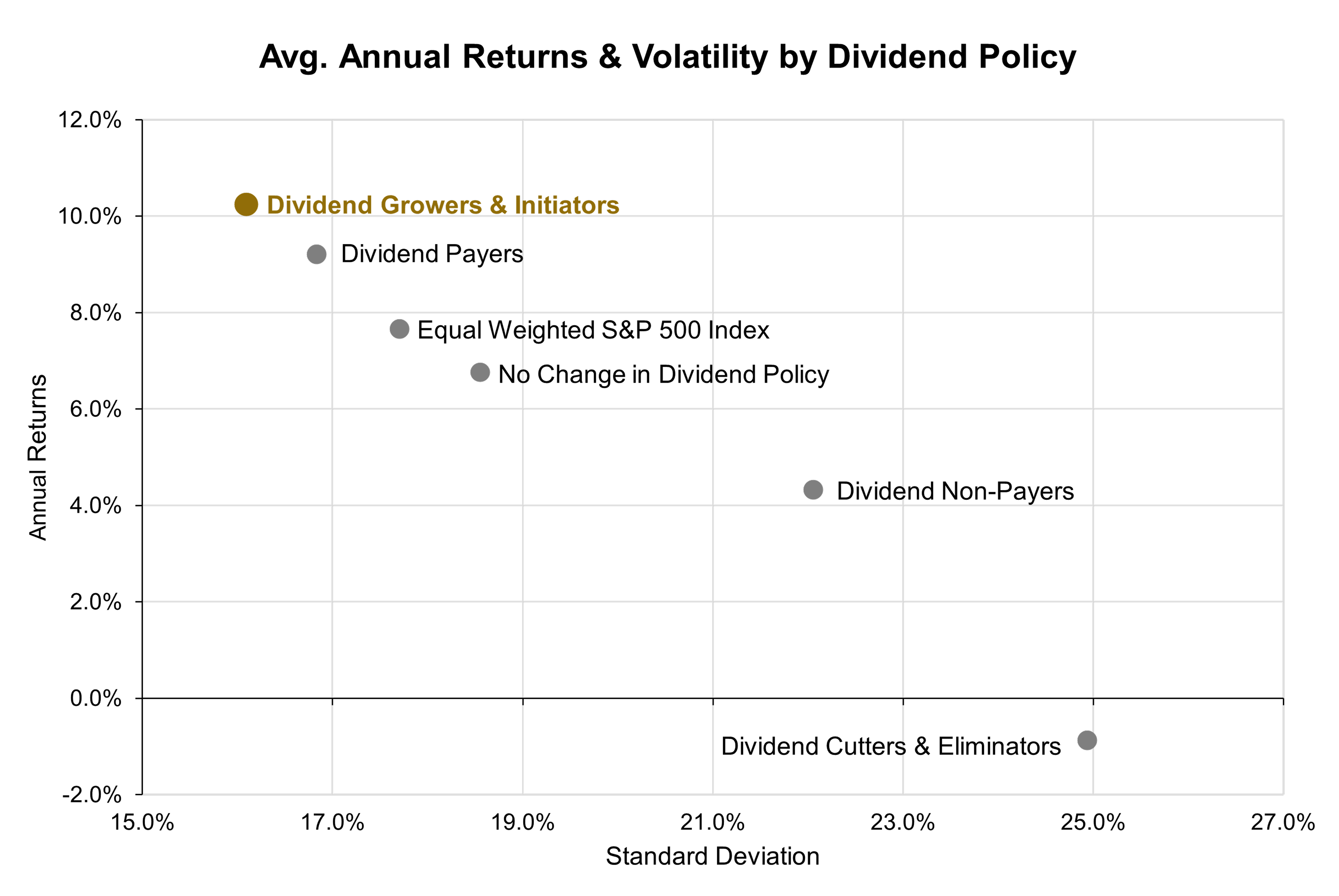
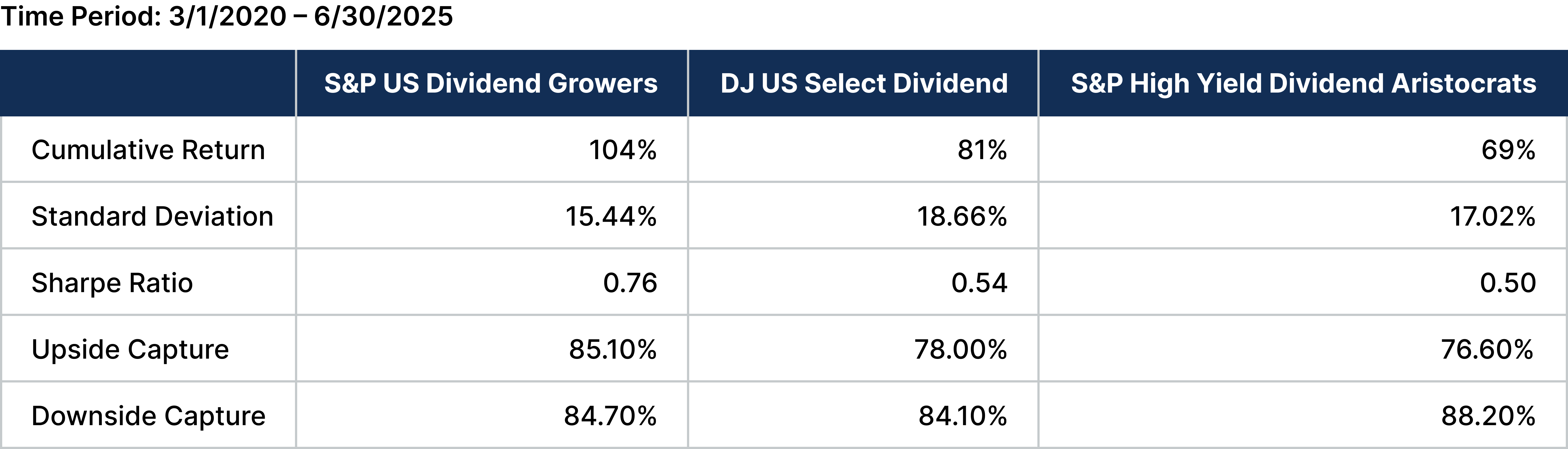
When researching dividend-paying stocks, investors often focus on the current dividend yield—the rate of payout their investment is generating now. This is understandable, as a typical goal of a dividend-focused investor is to generate current income. But only paying attention to the current yield misses out on what we believe is the real power of dividends: the potential growth of future income from your investment. For dividend stocks, we think this concept is best illustrated by a metric known as yield-on-cost, which we believe has several strategic advantages over merely focusing on current yield.

Yield-on-cost is calculated by dividing the annual dividend income by the original purchase price of the investment. This measure reflects how much an investor is earning on their initial investment over time. Looking through this lens can help illustrate the potential for the long-term growth in income from dividend-paying stocks.

Rising Dividends, Rising Income

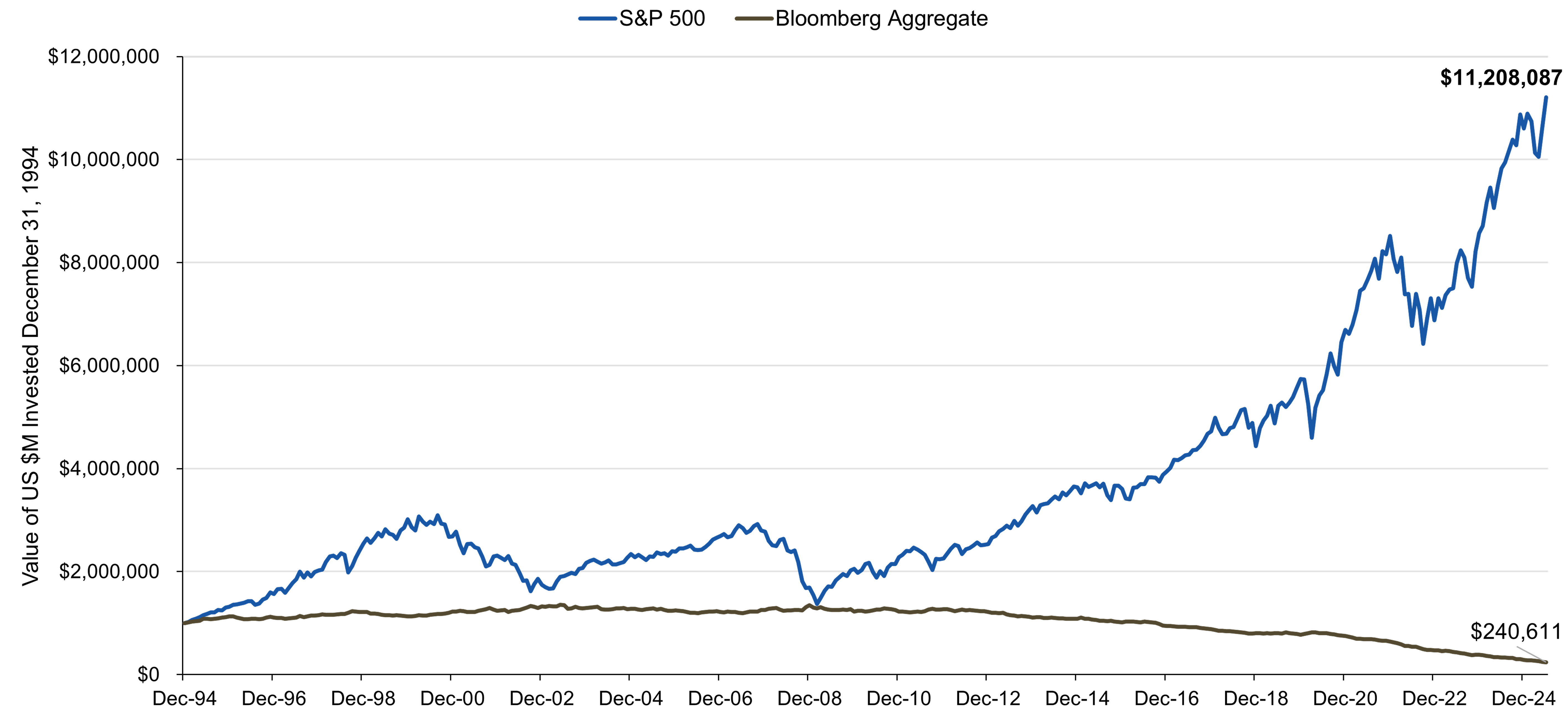
A good way to visualize this concept is to compare the income generated over time by an initial investment of $10,000 in each of the S&P 500® Index and the Bloomberg U.S. Aggregate Bond Index (see Figure 1). Investments in bonds and related vehicles like bond-index funds are expected to produce higher current income as compared to dividend stocks, and we see this behavior in the first few years depicted in the chart. Yet over time, the earnings growth of the S&P 500 companies leads to higher annual income. (The ending market value figures reflect price appreciation only, as the chart assumes that dividends are being withdrawn each year.)

Figure 1. Comparing Income Generated by Bonds and Dividend Stocks Over the Long Term

Annual dividend income (S&P 500) and interest income (Bloomberg Aggregate) on $10,000 invested on January 1, 1979 (1979-2023)

Figure 1
Source: FactSet. A company's dividend payments may vary over time, and there is no guarantee that a company will pay a dividend at all. Past performance is not a reliable indicator or guarantee of future results. For illustrative purposes only and does not represent any specific portfolio managed by Lord Abbett or any particular investment. Indexes are unmanaged, do not reflect the deduction of fees and expenses, and are not available for direct investment.

It is important to note that over this time horizon, the S&P 500 dividend yield averaged 2.5% while the yield on the Aggregate Index averaged 6.7%. But if we focus on yield-on-cost, we see that our initial investment in the stock market is yielding more than 74% as compared to its bond alternative at 2.36%.

The experience of one of the most well-known investors of our time, Warren Buffett, underscores the importance of yield-on-cost. In 1994, Buffett’s company, Berkshire Hathaway, completed a seven-year purchase of Coca-Cola shares for $1.3 billion. The cash dividends from that investment produced $75 million of income for Berkshire in 1994. As of this writing, Coke’s current yield is around 3% and has been for the last 15 years (see Figure 2). While some may see the stagnant yield as a detriment, the annual dividend has grown 242% while the stock price appreciated by 160% over this period. As a result, those cash payouts grew to $736 million by 2023, resulting in a yield of 57% on the initial investment. Should the soft-drink giant continue its multi-decade run of sustainable growth and annual dividend hikes, the yield on cost will continue to increase as well. 

Figure 2. Dividend Increases Fueled Rising Income from Coke Shares Even as Yield Remained in Narrow Range

Berkshire Hathaway’s annual dividend income from its mid-1990s Coca-Cola investment (left axis) and Coca-Cola’s dividend yield over time (right axis), 1994-2023

Figure 2
Source: FactSet. A company's dividend payments may vary over time, and there is no guarantee that a company will pay a dividend at all. Past performance is not a reliable indicator or guarantee of future results. For illustrative purposes only and does not represent any specific portfolio managed by Lord Abbett or any particular investment. Indexes are unmanaged, do not reflect the deduction of fees and expenses, and are not available for direct investment.

Quality Counts

The Coke example highlights the importance of finding quality companies within the dividend-paying universe. Within the universe of dividend-paying stocks, we believe investors can benefit by focusing on companies with a long history of dividend growth. These companies typically have stable earnings, robust cash flows, and a disciplined approach to returning capital to shareholders. This focus naturally aligns with selecting quality stocks that can sustain and grow their dividends over time, reducing the risk of income instability. In contrast, a focus on current yield may lead investors toward higher-yielding, but potentially riskier, companies.

Research has shown that the companies with the highest dividend yields have historically lagged the broader universe of dividend-paying stocks. These companies can face high volatility dealing with challenges maintaining its dividend or can have limited equity market participation as “bond proxies” (securities in sectors like real estate, utilities, and consumer staples that have high valuations with relatively low earnings growth). In addition, these “bond proxies” tend to be very interest-rate sensitive and can face headwinds during periods of rate volatility.

We think the potential long-term benefits of dividend-paying stocks are clear. However, we believe a thoughtful approach to dividend investing is vital to accessing these benefits while balancing risk and reward. We believe it is important to target quality companies that are not only willing to increase their dividend but are also able to do so in a manner that keeps their future growth intact.