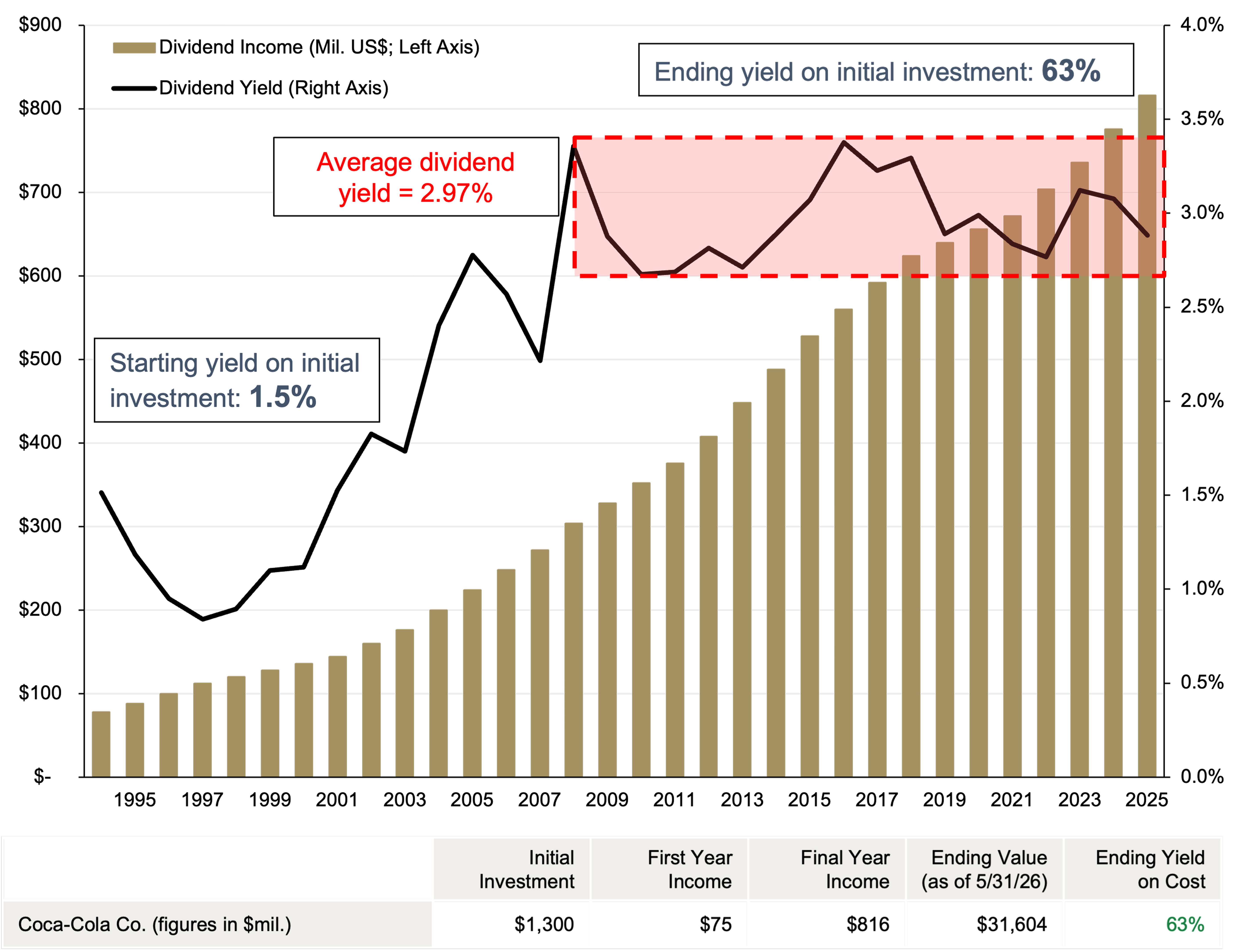
When researching dividend-paying stocks, investors often focus on the current dividend yield—the rate of payout their investment is generating now. This is understandable, as a typical goal of a dividend-focused investor is to generate current income. But only paying attention to the current yield misses out on what we believe is the real power of dividends: the potential growth of future income from your investment. For dividend stocks, we think this concept is best illustrated by a metric known as yield-on-cost, which we believe has several strategic advantages over merely focusing on current yield.
Yield-on-cost is calculated by dividing the annual dividend income by the original purchase price of the investment. This measure reflects how much an investor is earning from their initial investment over time. Looking through this lens can help illustrate the potential for the long-term growth in income from dividend-paying stocks.
Rising Dividends, Rising Income
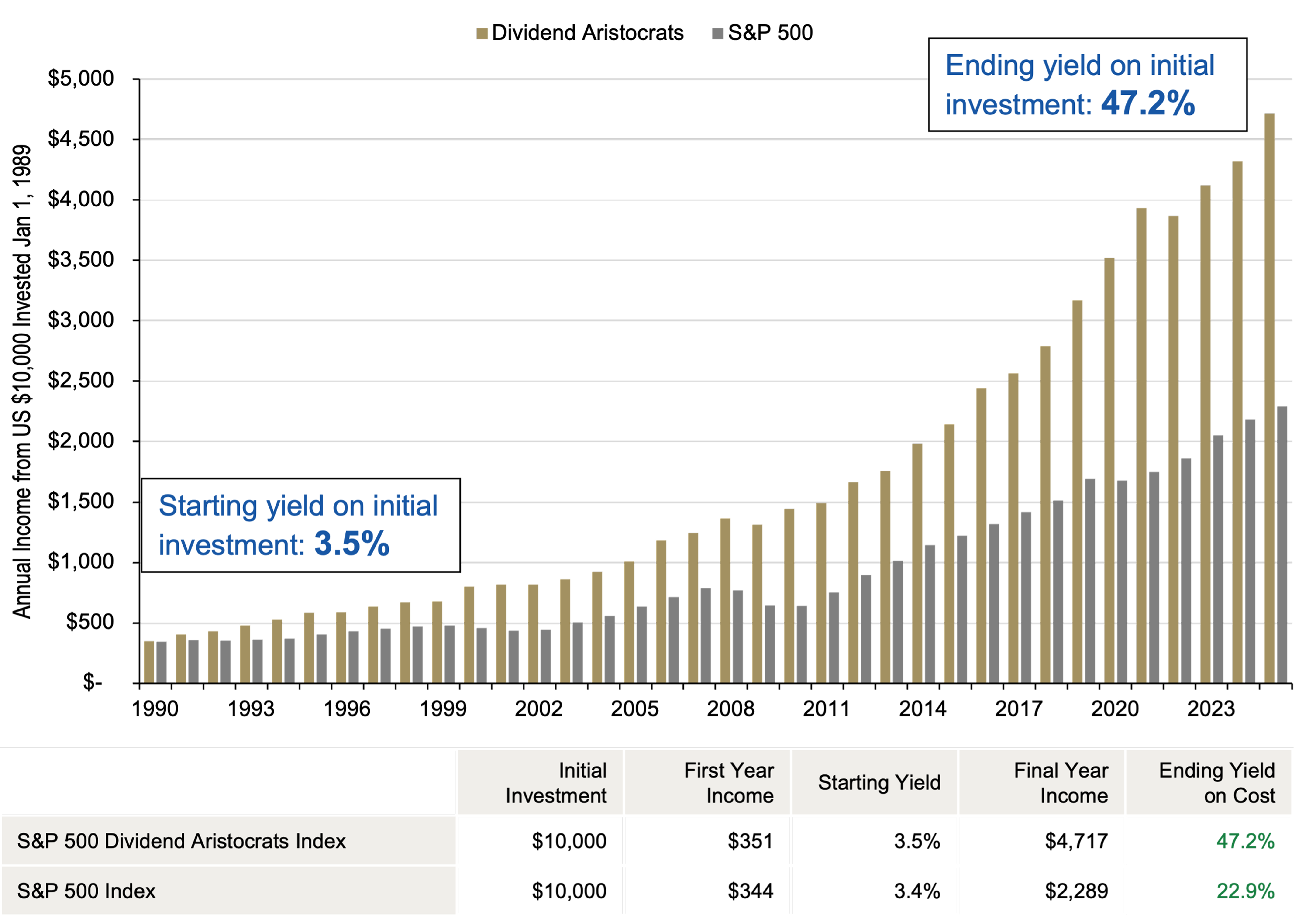
A good way to visualize this concept is to examine the income generated over time by an initial investment of $10,000 in the S&P 500® Index and the S&P 500® Dividend Aristocrats Index®, which measures the performance of S&P 500 companies that have increased dividends every year for the last 25 consecutive years (see Figure 1). Taken by itself, the initial yield on both indexes in 1989 is not an eye-popping figure compared to the yields available on other asset classes at that time. This is where a long-term focus and the power of growing dividends become important. Over time, the strong dividend growth of those S&P 500 Aristocrats led to an income stream more than twice as large as its broader counterpart (as the chart assumes that dividends are being withdrawn each year).