Despite concerns about inflation and slowing growth, strong corporate earnings continued to provide support.

Despite the ever-growing “wall of worry”—namely, concerns about inflation, slowing economic growth, and tariff uncertainties—U.S. equity markets continued their march higher in the third quarter of 2025. In fact, the S&P 500® Index’s return of 8% was well above the long-term average of around 1.5%, setting the stage for the seasonally strongest part of the year.

Among S&P 500 component sectors, Information Technology, Consumer Discretionary, and Communication Services led in the quarter. But participation in the market’s advance was again widespread, with all sectors outside of Consumer Staples delivering a positive return.

The real standout in the third quarter was small caps. The Russell 2000® Index returned more than 12%, outpacing its large cap counterparts by roughly 500 basis points (bps). This is a noteworthy change from the large cap leadership that has persisted in recent years, and a trend we will closely monitor in the future.

It’s worth pointing out that despite the concerns referenced above, corporate earnings have remained resilient. As we noted in an earlier comment, first- and second-quarter earnings for the S&P 500® Index beat expectations by a wide margin. Third-quarter earnings were expected to follow suit; indeed, based on FactSet data, warnings growth for the rest of the year, and for 2026, is expected to be in double digits. 

Potential Impacts of a Fed Easing Regime

Equities received another boost in September, when, after long anticipation, the U.S. Federal Reserve (Fed) cut rates by 25 bps—the first rate cut since December 2024. Policymakers signaled that two more cuts are likely this year. As Figure 1 illustrates, markets have generally responded well to the implementation of a Fed rate-cut cycle, when the economy is not in a recession.
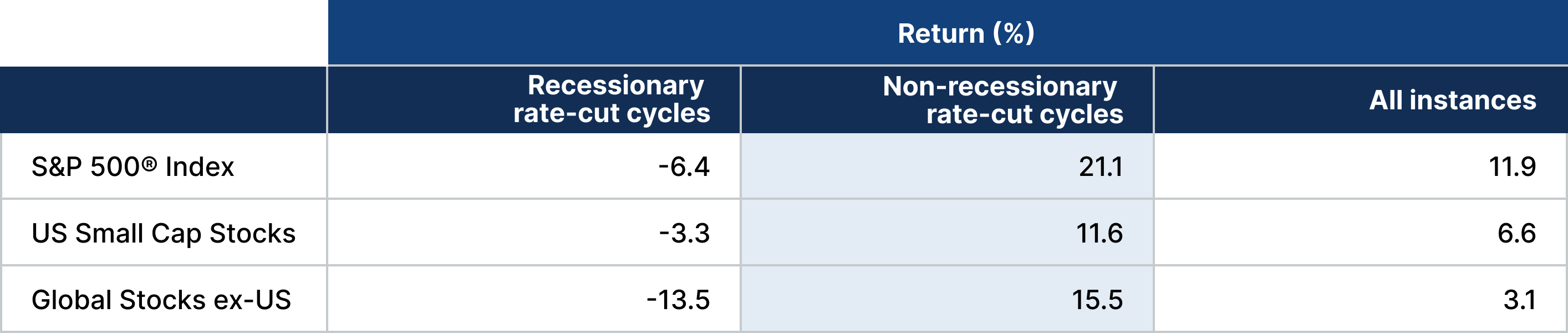
Figure 1. How Have Equities Fared After the Start of Fed Rate-Cut Cycles?

Average 12-month forward return from the date of the first rate cut in the eight Fed easing cycles since 1984

Chart Showing Average 12-month forward return from the date of the first rate cut in the eight Fed easing cycles since 1984
Source: Bloomberg. US Small Cap Stocks = Russell 2000 Index. Global Stocks ex-US = MSCI All Countries World Index ex-US.  Start dates of the last eight Fed rate-cut cycles: 10/2/84, 10/19/87, 6/5/89, 7/6/95, 1/3/01, 9/18/07, 7/31/19, and 3/3/20.
Past performance is not a reliable indicator or guarantee of future results. The historical data shown in the chart above are for illustrative purposes only and do not represent any specific portfolio managed by Lord Abbett.

While we are bottom-up investors, we do expect more accommodative monetary policy, combined with deregulation and tax breaks for lower-income consumers, to be a favorable recipe for value equities into year-end.

The ultimate impact of rate cuts will take time, but expectations for the benefits to flow, both to the consumer and industrial economy, are encouraging. For the consumer, lower borrowing costs should be a benefit, particularly with a decline in credit card rates combined with tax relief. With changes to the U.S. tax code, including auto loan deductions and the removal of taxes on overtime and tips, consumers should see at least a modest increase in spending power in early 2026. Time will tell if rate cuts result in lower mortgage rates, which would also be positive.

Meanwhile, on the business side of the coin, lower borrowing costs, combined with deregulation and investment incentives, such as accelerated depreciation, could spur incremental domestic investment.

A Final Word

After the market’s strong advance, should investors disregard the “wall of worry”? Of course not. The market could still be influenced by unfavorable developments in the economic and monetary policy realms (in particular, we are monitoring any possible impact from the U.S. government shutdown that began on October 1). But absent any major changes in the investment landscape, we think the favorable conditions supporting the market are likely to remain in place. 

Spotlight: The Innovation Engine

Wherever one looks–media, education, business, entertainment–one sees the impact of artificial intelligence (AI). And, because so much attention has been focused on the mind-rattling breakthroughs in tech, the incredible wave of innovation happening elsewhere in the economy has been less noticed. But the innovation engine is powering many industries, both old and new.

Here are two examples:

In transportation, autonomous driving tech company Waymo (a unit of Google parent Alphabet) is providing services in five major U.S. metropolitan areas, with several other metro areas being mapped for future rollout. In the third quarter, the company hit 100 million autonomous miles driven. Tesla formally entered the driverless car fray in the third quarter as well. It’s not unreasonable to think these cars will be a part of everyday life for many of us within the decade.

The pace of innovation is also accelerating in healthcare. As the cost of sequencing genes has plummeted, data have proliferated. Companies are now using massive data sets to drive precision diagnostics and testing. Companies are finding breakthroughs in liquid biopsy, genetic testing, and cellular therapy. Revolutionary technologies tend to create new and exciting investment opportunities, both directly and indirectly.

The innovation engine, already powerful, is shifting into a higher gear.