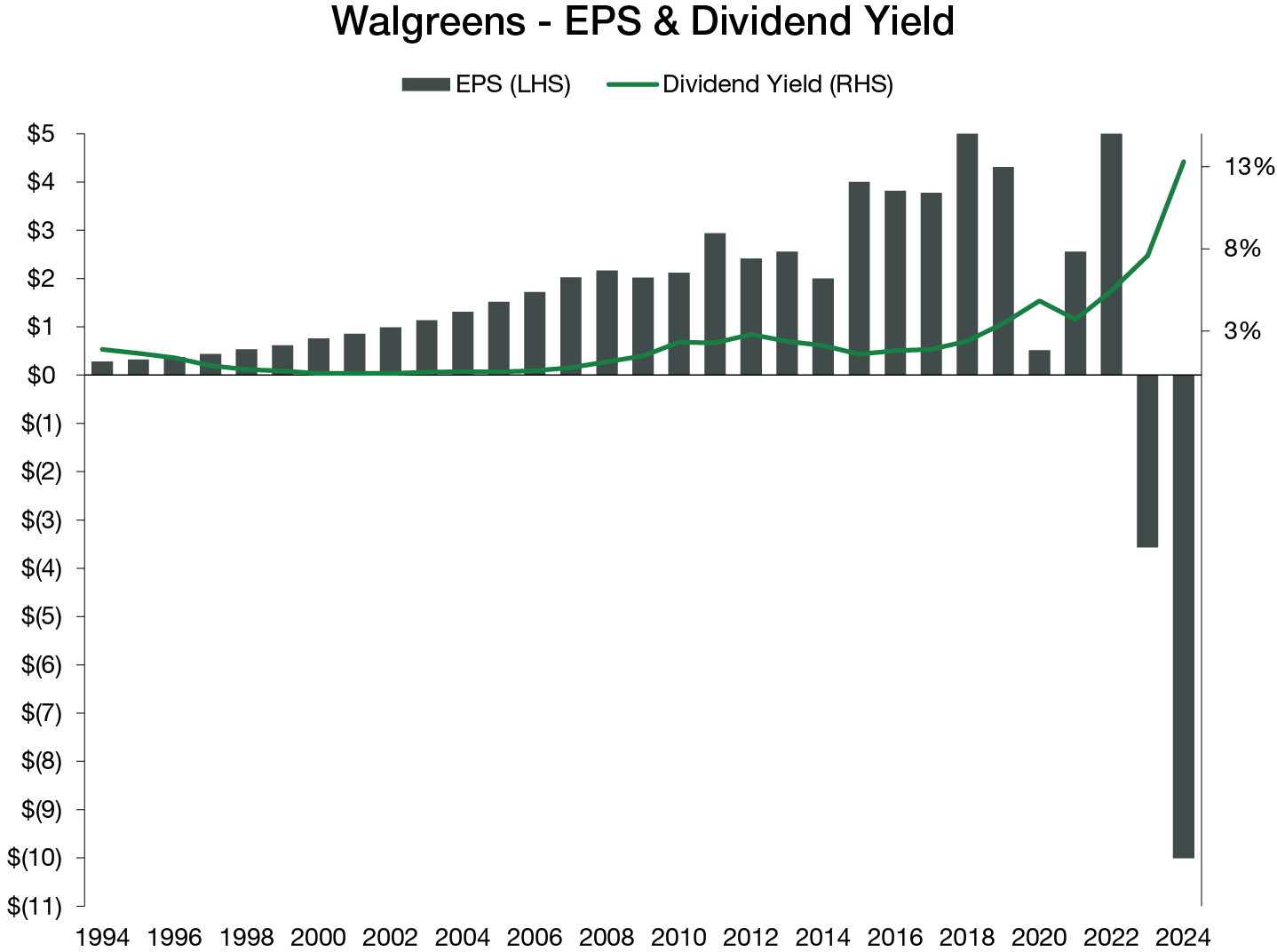
Walgreens and Coca-Cola are two household names that both had a long-standing history of increasing their dividends annually. Yet, in early 2024, Walgreens cut its dividend nearly in half before opting to fully suspend its quarterly payout at the beginning of 2025, while Coca-Cola has continued to grow its dividend.

In the wake of the Walgreens news, we thought it would be useful to take a fresh look at the factors that determine a company’s dividend trajectory, whether it is continued growth in the dividend, or an eventual reduction, or even cessation, of payouts.  A brief look at the fundamental and dividend history of these famous franchises (through calendar 2024, the last year in which Walgreens paid a dividend) provides us with what we consider good examples of both outcomes, highlighting why we think it is important for dividend-focused investors to look under the hood at the strength and resiliency of the company itself (illustrated here by historical earnings data) rather than solely chasing stocks with high dividend yields. 

Coca-Cola

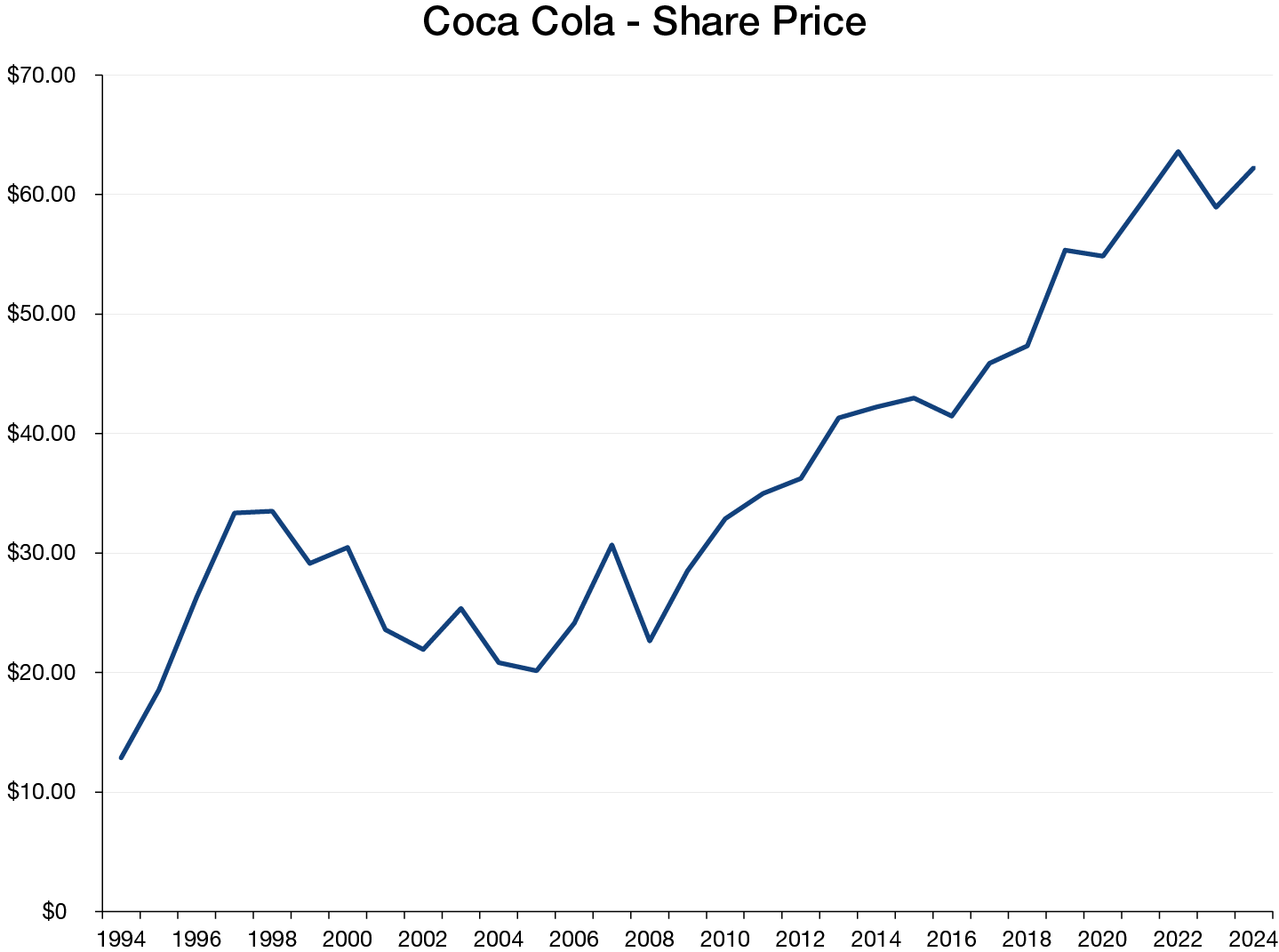
Coca-Cola has increased its dividend by 8% annually over the past 30 calendar years, and this period has been highlighted by Coke’s long-term record of stable earnings growth and its consistent history of returning those profits to its shareholders. Over the past 10 years, Coke’s average dividend yield was 3.1%, as stock price and dividend-per-share amounts increased in tandem. While there are no guarantees, Coke’s long-term history of stable earnings growth and leadership by an effective management team suggest that its record of annual dividend growth will remain intact. And so, while the absolute dividend yield per share is modest, we believe the growth of Coke’s dividend year after year has been a clear signal of quality at the company, along with its ability to adapt to changing tastes and consumer preferences. That consistency has been reflected in the steady climb in its stock price, in our view.
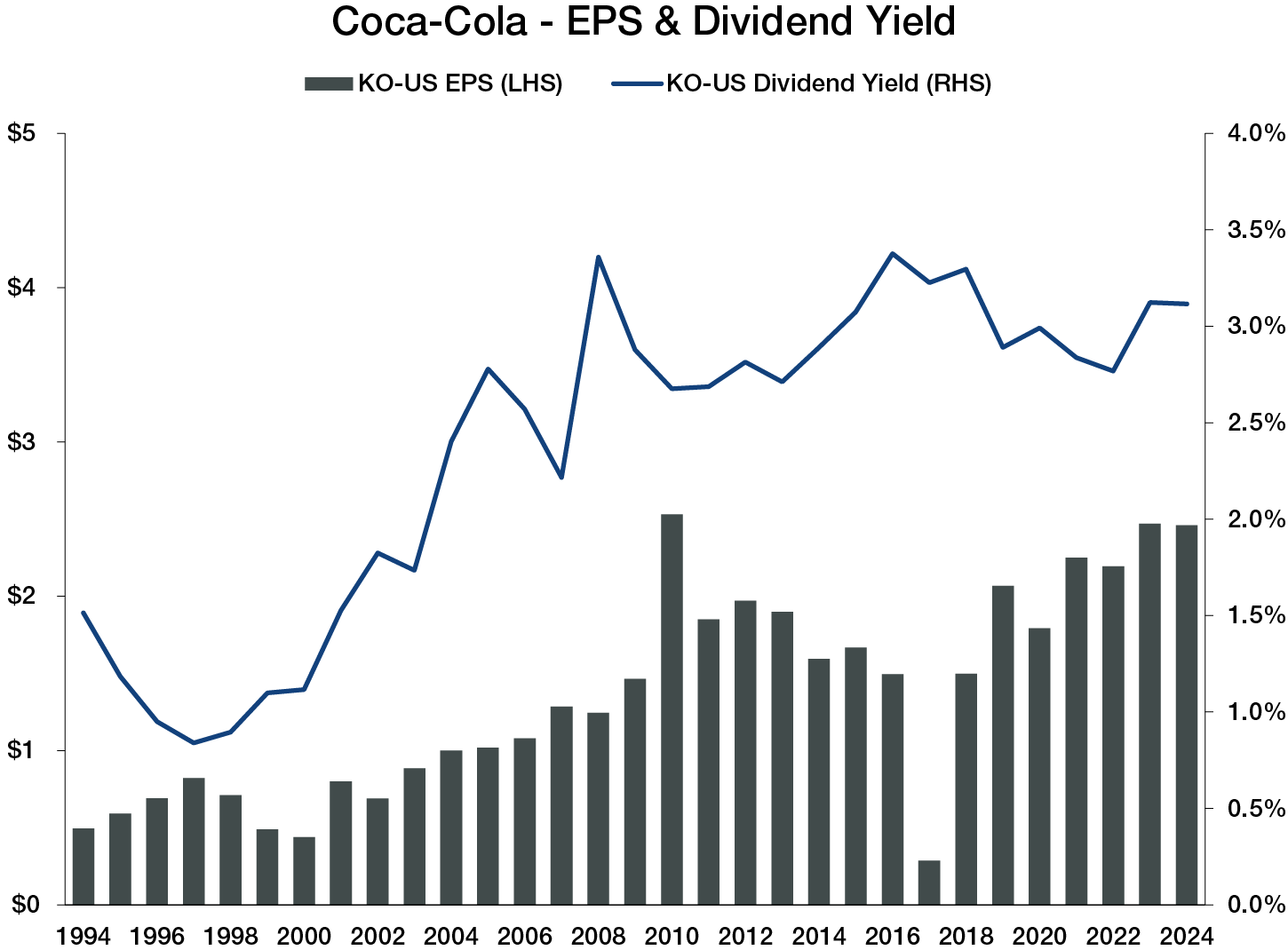
Coca Cola EPS & Dividend Growth over the last 30 years bar chart
Coca Cola Share Price over the last 30 years line chart

Source: FactSet. Data for the calendar years 1994-2024 (as of 12/31/2024). LHS = left-hand side. RHS = right-hand side. EPS = earnings per share.

A company's dividend payments may vary over time, and there is no guarantee that a company will pay a dividend at all. Past performance is not a reliable indicator or guarantee of future results. For illustrative purposes only and does not represent any specific portfolio managed by Lord Abbett or any particular investment. Indexes are unmanaged, do not reflect the deduction of fees and expenses, and are not available for direct investment.

Walgreens

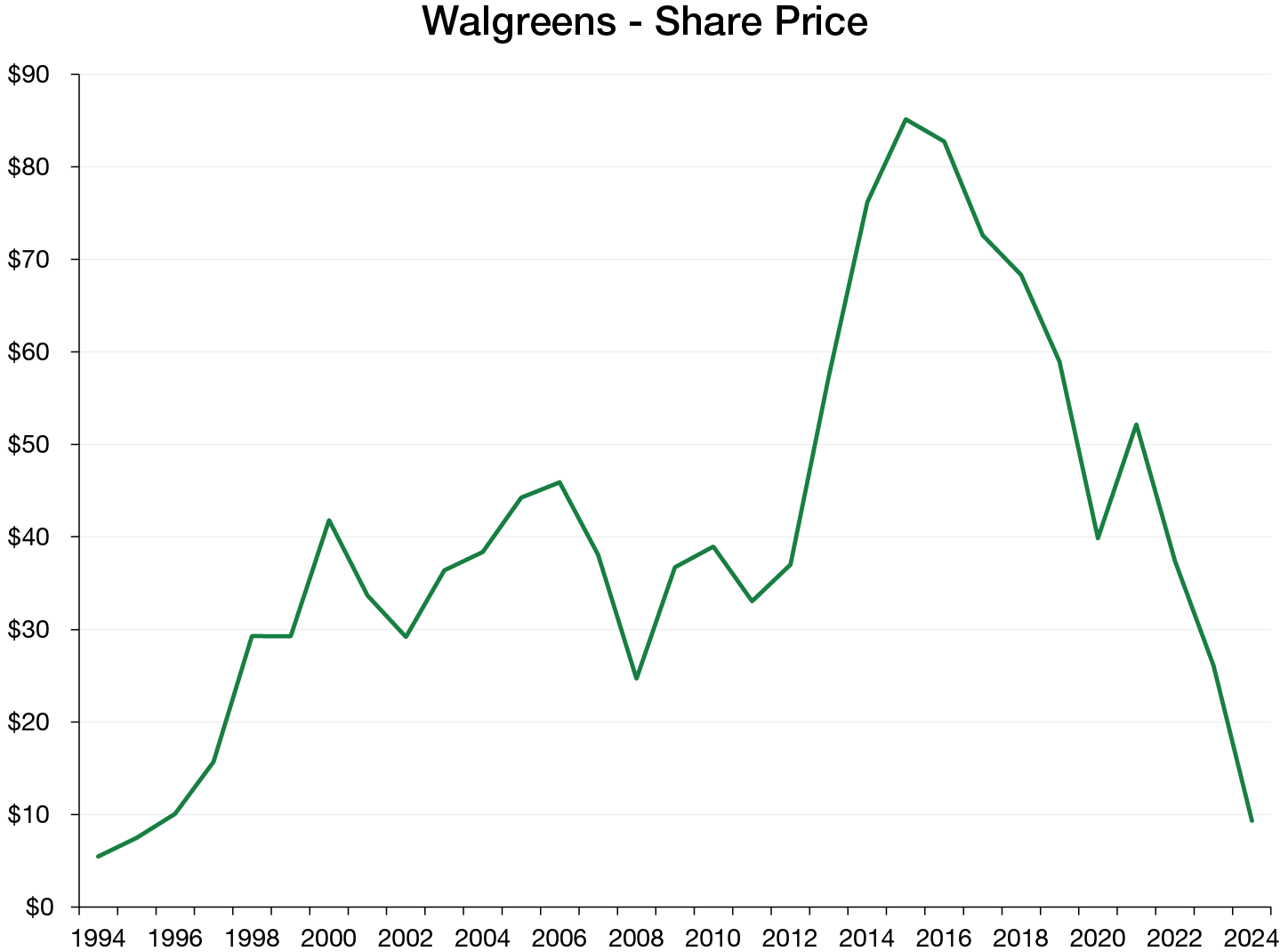
By contrast, Walgreens has seen its profits erode in the past 10 calendar years as the competitive landscape shifted for retail pharmacies. Yet, until the dividend suspension in 2025, Walgreens had lifted its payout by 9.2% annually over the preceding 30 calendar years. Moreover, in recent years, the company continued to boost its dividend and took on more debt as earnings weakened. Inevitably, the stock price dropped, leading to a jump in the dividend yield from 2% in 1994 to 13% before payouts were suspended in January 2025. That yield is now zero, and the stock price fell 85% over that period. At one point in 2014, Walgreens had a market capitalization of nearly $100 billion. In March 2025, the company agreed to be acquired by a private equity firm at a 90% discount to that peak value, with the acquisition expected to be completed in the fourth quarter of 2025, based on a Bloomberg news report.

Walgreens EPS & Dividend Yield over the last 30 years in a bar chart
Walgreens Share Price over the last 30 years in a line chart

Source: FactSet. Data for the calendar years 1994-2024 (as of 12/31/2024). Walgreens suspended its dividend 01/30/2025. EPS = earnings per share. LHS = left-hand side. RHS = right-hand side.

A company's dividend payments may vary over time, and there is no guarantee that a company will pay a dividend at all. Past performance is not a reliable indicator or guarantee of future results. For illustrative purposes only and does not represent any specific portfolio managed by Lord Abbett or any particular investment. Indexes are unmanaged, do not reflect the deduction of fees and expenses, and are not available for direct investment.

A Final Word

What does this mean for the dividend-focused investor? Passive dividend growth strategies have proved popular in recent years, but basing a portfolio allocation decision solely on companies’ dividend payout history means potentially missing important developments that can have an impact on the ability of such companies to raise, or even maintain, a dividend in the future. The diverging fortunes of Coke and Walgreens—and the impact on their historical dividend payments—provide a clear illustration of the potential benefits of an actively managed approach to dividend stocks to provide alpha to investors.