2026 Midyear Investment Outlook: Private Credit’s Lender-Friendly Reset

Stronger deal flow, more selective capital, and better documentation have improved the setup for new loans, even as headlines and portfolio stress increase dispersion across managers.

From Tailwinds to a Reset

Our 2026 year-ahead outlook highlighted a more constructive backdrop for private credit, supported by improving mergers and acquisitions (M&A) activity, normalizing interest rates, and a market that appeared poised to move back toward lender discipline. At midyear, that broad view still holds. But the most important development is not simply that the tailwinds remain in place. It is that the market has reset in a more lender-friendly direction.

Private credit entered the year after a long, tight period. Since rates rose in 2022, capital markets activity had been more muted, which meant fewer transactions needed financing. At the same time, fundraising across private credit remained strong, leaving a lot of capital chasing a limited number of deals. That environment favored borrowers: Spreads ground tighter; leverage moved higher; and loan documents often became more flexible.

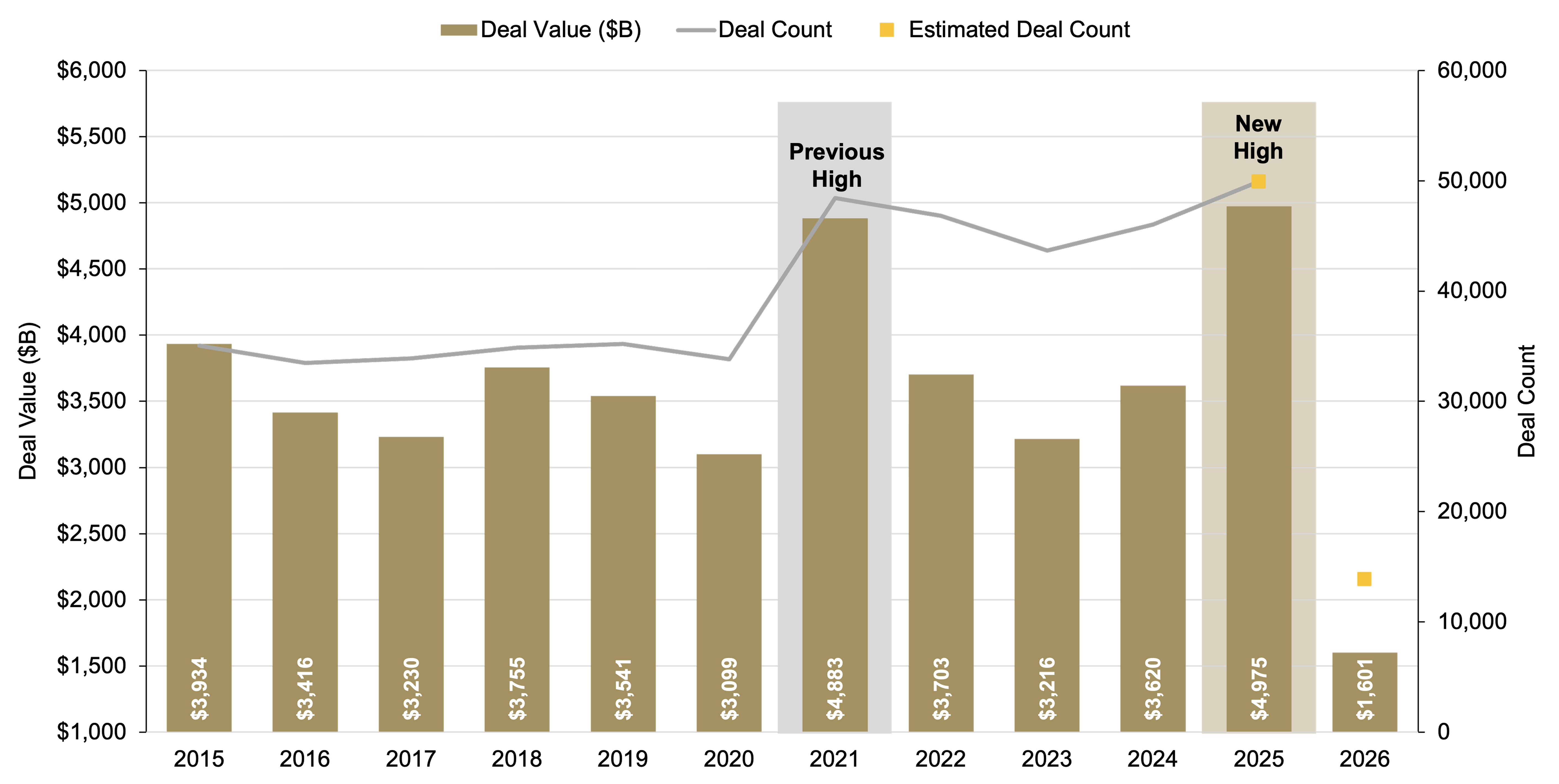
That began to change late last year as M&A activity picked up, and deal flow improved. And the momentum appears to have continued into early 2026. While Figure 1 shows that 2025 surpassed the prior 2021 high in annual global M&A activity, early 2026 data suggest that deal value remained strong in the first quarter, supported in part by larger transactions. For private credit lenders, the implication is important: A more active transaction backdrop can expand the opportunity set. At the same time, more recent headlines around software exposure, AI disruption, non-accruals, PIK activity, and redemptions in certain vehicles have made some capital providers more selective. Together, those two forces have improved the supply-demand balance for lenders with dry powder: more transactions to finance, less capital competing aggressively for each transaction, and greater ability to negotiate price and structure.

Figure 1. A Shift Toward a More Lender-Friendly Backdrop

Global M&A activity by year, 2015–2025

Combined bar and line chart shows global deal value fluctuating between about $3.1T and $4.9T from 2015–2024, reaching a new high near $5.0T in 2025 alongside rising deal counts, with an estimated drop in 2026.
Source: PitchBook. Data as of March 31, 2026. Total deal count in 2025 includes estimated values from Pitchbook for the fourth quarter. The historical data is for illustrative purposes only and does not depict or predict the performance of any specific portfolio managed by Lord Abbett or any particular investment. Indexes are unmanaged, do not reflect the deduction of fees or expenses, and are not available for direct investment.

In practical terms, we have seen spreads widen by roughly 50 to 100 basis points higher since late 2025, while defensive terms have also improved, according to PitchBook. But the spread move is not the whole story. In our view, the more important change is that new loans are increasingly coming with better credit structures: less leverage, more covenants, fewer PIK requests, and tighter documentation. That makes today’s environment potentially more attractive for disciplined lenders than the tighter conditions that prevailed six months ago.

The Story Is Bigger Than Software

Software and AI have dominated the private credit narrative this year. That focus is understandable. Private leveraged finance markets have a higher allocation to software than liquid leveraged finance markets, with software representing about 20% of private market exposure versus roughly 13% in the liquid market, according to data from PitchBook and the Morningstar LSTA US Leveraged Loan Index, as of December 31, 2025. That makes the issue important, but it should not define the entire asset class.

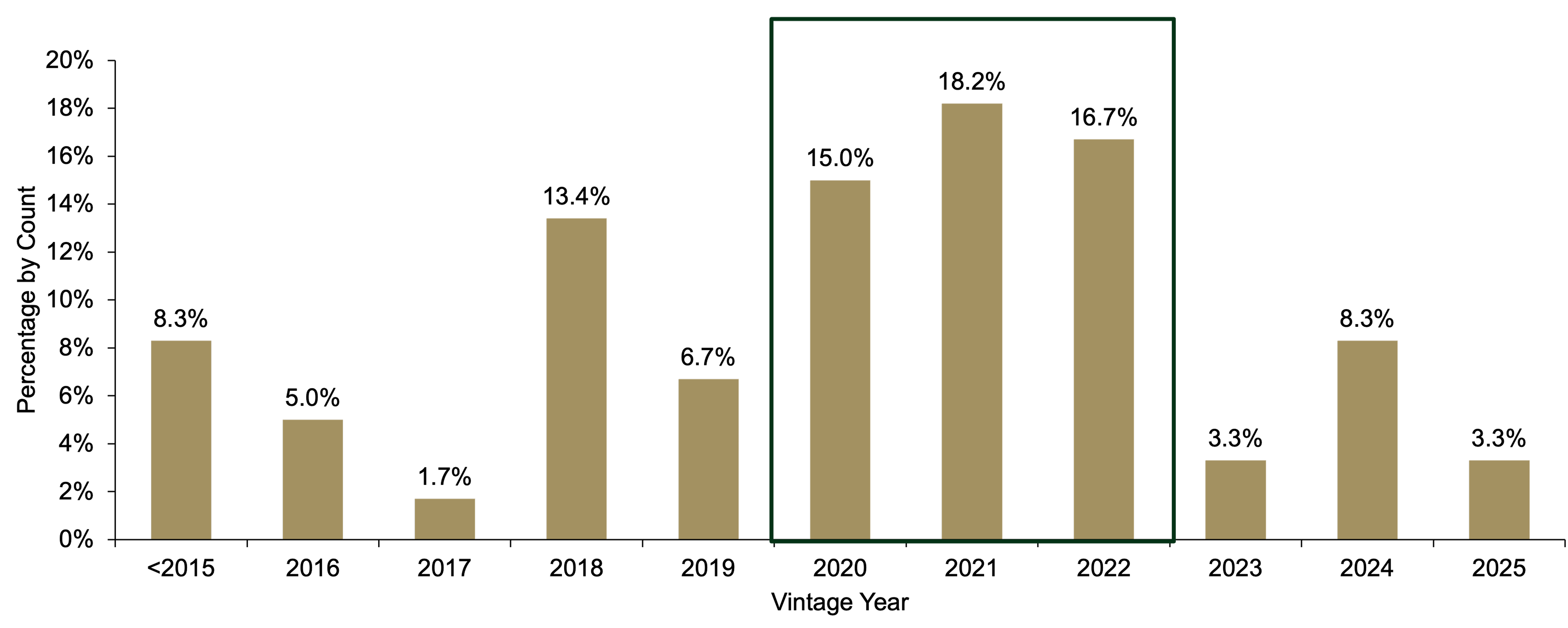
The focus on software has also been rooted in vintage. A large number of enterprise software transactions were financed between 2019 and 2022, when rates were low; capital was abundant; and AI disruption was not yet a central underwriting concern (see Figure 2). In some cases, these companies had strong revenue growth and attractive products, but they were not yet generating meaningful profits or free cash flow. Instead, they were reinvesting heavily into sales, marketing, programming, and customer acquisition. That made the loans more exposed to higher rates and changing assumptions around enterprise value.

Figure 2. Software Deal Activity Was Elevated in the 2020-2022 Vintage

Software deals as a percentage of deal count by vintage year, 2015–2025

Bar chart shows percentage of deals by vintage year, with the highest concentration in 2020–2022 (peaking at 18.2% in 2021) and lower shares before 2018 and after 2022.
Source: Citi Research and PitchBook. Data as of December 31, 2025. Most recent annual data available. The historical data is for illustrative purposes only and does not depict or predict the performance of any specific portfolio managed by Lord Abbett or any particular investment. Indexes are unmanaged, do not reflect the deduction of fees or expenses, and are not available for direct investment.

We do not dismiss software risk. Some software loans may underperform, and the sector may contribute to greater dispersion among managers. But we do not believe the right conclusion is that all software exposure should be treated the same. Profitable, cash-generative software companies are different from pre-profitability annual recurring revenue (ARR) borrowers. Durable, mission-critical software businesses are different from companies whose products may be more vulnerable to AI substitution.

That distinction matters because the broader private credit cycle is also normalizing. Private credit is part of leveraged finance, and leveraged finance borrowers are sub-investment-grade credits. Defaults, restructurings, and recoveries vary across cycles. The key question for the second half is not whether there will be any stress, but where that stress is concentrated, and whether investors are being paid and protected appropriately for the risk.

Why Structure and Underwriting Matter More Now

We believe the improved market backdrop does not reduce the need for underwriting discipline; it increases the value of it. A more active market gives lenders more to choose from, but stronger deal flow is usually only helpful if a manager has the ability and discipline to say no.

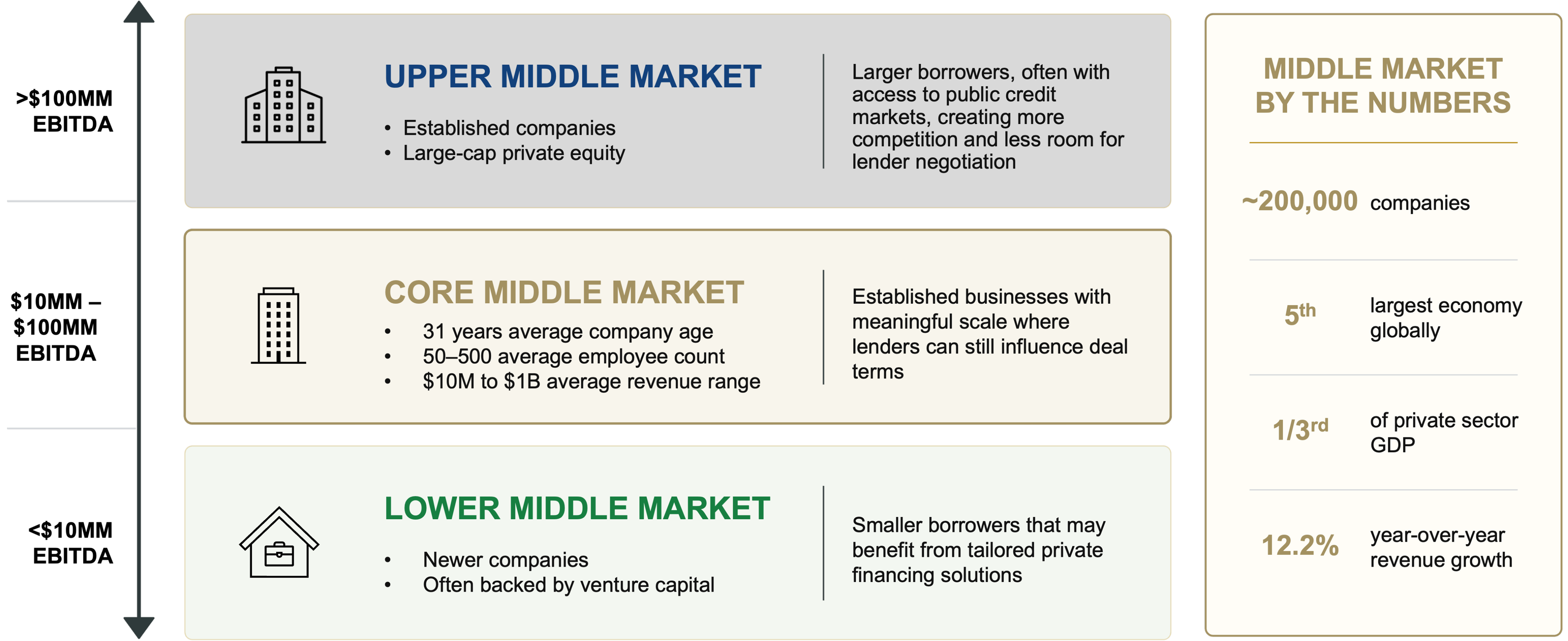
In our view, the core middle market remains a particularly important segment. These are companies large enough to have scale and operating history, but generally not large enough to rely on the liquid markets as a competing financing source. That matters because borrowers with liquid market alternatives can pressure private lenders to give up spread, covenants, or other structural protections. In the core middle market, lenders typically have more time to conduct diligence and more ability to influence documentation.

Figure 3. A Borrower-Size View of Private Credit Tradeoffs

Visual Image Showing A Borrower-Size View of Private Credit Tradeoffs
Source: Lord Abbett; National Center for the Middle Market (NCMM), Middle Market Indicator Year-End 2025 and historical data through Q4 2025. Data as of December 31, 2025. Most recent data available. The Middle Market Indicator (MMI) is a survey-based economic gauge of U.S. middle market companies, typically defined as companies with $10 million to $1 billion in annual revenue. Revenue cohorts reflect NCMM definitions, not EBITDA. NCMM core middle market is defined by revenue ($50M to <$100M). The historical data is for illustrative purposes only and does not depict or predict the performance of any specific portfolio managed by Lord Abbett or any particular investment. Indexes are unmanaged, do not reflect the deduction of fees or expenses, and are not available for direct investment.

Other underwriting factors that should be considered include: less cyclical industries, companies with stable or growing free cash flow, durable competitive advantages, strong management teams, and sponsors or owners with a record of supporting their businesses.

EBITDA can be a useful shorthand for profitability, but it is not cash. Free cash flow is what supports interest payments. Loan-to-value, meanwhile, helps frame the margin of safety around principal repayment. A lower loan-to-value means the lender is advancing a smaller portion of the company’s value, which can provide a cushion if operating performance weakens, or market valuations decline.

This is why we believe the current environment favors active, experienced private credit managers. More deal flow and wider spreads are constructive, but the most durable advantage may come from better documentation, more conservative leverage, and the time to conduct stress analysis before capital is deployed.

Three Things We’re Watching in the Second Half

  1. Portfolio differentiation

    We expect the gap between stronger and weaker portfolios to become more visible as the year progresses. Non-accruals, PIK usage, sector concentration, and 2021-2022 vintage exposure should remain important indicators. We are already seeing signs of greater differentiation, particularly in portfolios with exposure to older vintages and more aggressively financed software-related credits. In our view, this is not a broad indictment of private credit, but rather evidence that manager discipline, sector selection, and underwriting standards are beginning to matter more.
  2. Dry powder versus redemption pressure leading to portfolio divergence

    We are also monitoring whether redemption pressure in certain vehicles widens the gap between managers that may take advantage of today’s improved lending conditions and those that may be more constrained by existing portfolio conditions. From a new-lending perspective, less capital available to compete for deals can improve pricing and structure for managers with dry powder. But redemptions can also change the composition of affected portfolios. If healthier, more liquid loans repay or roll off first, the remaining portfolio may have a higher percentage of non-accruals or PIK loans, even if the absolute number of challenged credits does not change. That dynamic could contribute to additional headline risk and further manager dispersion.
  3. Stronger credit structures with attractive spreads

    Finally, we are watching whether recent improvements in loan structure continue. Before meaningful spread widening typically appears, lenders often first see what we would call better defense: fewer PIK requests, less aggressive leverage, more covenants, and stronger documentation. We have seen those defensive features improve in recent months, and we believe that matters more than modest spread widening alone. For lenders deploying new capital today, the most important shift is not just that potential income has improved, but that the underlying credit structure has improved as well.

Bottom Line: Constructive but Selective

We are constructive on private credit but not complacent. The asset class does not require perfect conditions to perform, and periods of volatility can help restore discipline by reminding borrowers and lenders that credit risk must be priced and structured appropriately.

For new capital, the setup appears better than it was six months ago. M&A activity appears to be creating more opportunities to lend. Capital has become more selective. Spreads are wider. Covenants and documentation are improving. And managers with dry powder can be more selective about the credits they choose to finance.

The second half of 2026 is likely to be defined by dispersion. We believe investors should focus less on broad asset-class headlines and more on where managers are lending; how loans are structured; how much free cash flow borrowers generate; and whether portfolios have the right balance of income, downside mitigation, and selectivity. In today’s private credit market, the opportunity is real, but the potential advantage may go to managers who can combine patience with discipline.