Andy D’Souza: Welcome back to The Investment Conversation. I'm Andy D'Souza, partner and chief marketing officer here at Lord Abbett. As part of our 2025 Midyear Outlook, we're going to talk with our investment leaders about key themes of the markets in the second half of the year across equities, municipal bonds, taxable fixed income, and private credit.

Today we're going to speak with Lord Abbett's director of equities, Matt DeCicco, a partner of the firm. Matt, great to have you here today.

Matt DeCicco: Glad to be back. Thank you.

D’Souza: A lot has changed since he's last spoke in our 2025 outlook podcast in January. At the time we were talking about solid economic growth, moderating inflation, robust corporate earnings, and good technical momentum for the major equity indices.

But then came April 2nd and the tariff announcement and the market's concerns about its potential negative impact on GDP growth and earnings. So, let's start with the big picture. It's been an eventful first half of the year so far. Matt, please bring us up to date on where the market stands as of today, May 13th.

DeCicco: Yeah, well, you hit it right on the head there with your background. We had a very strong start to the year, really up until mid-February, in which there was optimism about healthy economic growth, and inflation (as you said) was moderating. You have a new [U.S.] government which potentially is going to be deregulating.

And so, there was a good deal of optimism that really started the year strong. I would say that began to change in late February and in March, as folks began to anticipate, and it came out in some conversations from the administration that perhaps the tariffs were going to be larger than expected, leading up to of course, as you said, Liberation Day [the April 2 tariff announcement].

Now, where we stand today, the [estimated] initial size of the economic drag from tariffs was probably somewhere in the $700 billion or $800 billion range in the immediate aftermath of the announcement in early April. As of today [May 13], with the walk-back [of tariff percentages] post the Geneva meeting [tariff talks], it looks like the tariff impact will be more like $250 billion, which is manageable.

It's still certainly going to be a drag on growth but not nearly as great as what was viewed to be just a month ago. And I'd say you combine that with some fiscal stimulus that is getting closer into view and one can make the reasonable assumption that that $250 billion can be offset.

And maybe you have fiscal policy that's neutral this year or maybe even a little bit positive, whereas again, a month ago when the tariff drag was [seen at] about $800 billion it would have been hard to come up with fiscal policy that would have offset that.

I know that was a lot of conversation just about policy, but let's face it, that's been a big driver of the markets so far this year. So maybe I'll pause there. There's a lot more to talk about on earnings and sentiment, but maybe just I'll pause there just on what's happened so far in the market, getting us up to date on where policy stands.

D’Souza: Yeah, let's talk about sentiment a little more. You wrote a piece recently for lordabbett.com that talked about how market sentiment indicators showed a surge in uncertainty, obviously in bearishness after the tariff news. What do these and other market signals sort of suggest to you? How do you interpret them?

DeCicco: Yeah. So, let me take a few things. I'm going to do a little bit fundamentals and a little bit on sentiment and technicals [technical indicators] because I want to come back to the point that right after Liberation Day sentiment was very extreme. And I'm going to give you some numbers around that.

But since then, I think (we talked about tariffs being walked back but), the other positive, really has been how strong earnings have come in. So as of today, 90% of the S&P 500 [companies have] reported, and 70% of those companies came in on earnings better than expected, which is right smack in line with average.

So, companies generally beat earnings [estimates], and you didn't have anything that was unusually negative for this quarter. Additionally, the expectation was that generally companies beat their earnings forecast and generally they beat by about 4%. And this quarter, companies came in even better than that, coming in at about 8%.

So, what that means is that earnings growth this quarter will be roughly 10%, and earnings growth for the full year will be about 8%. The other thing I'd say is that just the guidance that companies gave over the back half of the year probably was a little bit more optimistic than market observers had expected.

I think there was a view or a fear that maybe companies would throw their hands up like they did in COVID and withdraw guidance all together. We actually didn't see much of that. And where that leaves us is that companies came in much better than expected and left their guidance unchanged or left their guidance fairly conservative, and then subsequent to that you've had (like we said earlier), some of this [U.S. tariff] policy being walked back.

So now you have a position where those earnings estimates may in fact be too low for the rest of the year. So, that's the earnings picture. Now, marry that with the sentiment picture. I won't go through all the sentiment measures that we look at, but I will call out two in particular that were very extreme.

The first is just the policy uncertainty index. A lot of people have written about this. I won't reiterate this but extreme levels of policy uncertainty in the aftermath of Liberation Day and really still exists today. And just historically, when you have these extreme measures in policy uncertainty, that tends to be very good for equity markets if you can look out six to 12 months.

The other one that was extreme is the Investors Intelligence bulls versus bears ratio. And this is a survey that's been around since 1964. It's very rare that bears outnumber bulls. It's only happened eight times in the last 15 years. It's usually marked important lows in the market, when bears outnumber bulls, and that's where we stood, after Liberation Day, and it's where we still stand today.

So, even with this rally in the market from 4,850 to up around 5,800 on the S&P 500 Index [as of May 13, 2025], you still have a large number of bears outnumbering the number of bulls. And so that's a fairly good setup that I just described to you, where we stand here today.

We've got earnings that came in better than expected. We have guidance that's set reasonably conservative. We just got a reduction in the [potential] economic drag from tariffs. That means that earnings could be revised up, not revised down, and you have positioning where most people are a little behind.

They were very, very bearish and remained bearish even after the rally in markets today. The last point on just tactical indicators: Right after Liberation Day we got to the point where only 7.5% of stocks in the Russell 3,000 [Index] were trading north of their 150-day moving average.

Generally, we would say below 20% of stocks trading above their 150-day moving average is a buy signal. Getting below 10% only happens 1% of the time. I know that's a lot of percentages I'm pointing at you. The point is that was a very extreme oversold condition, and now the opposite is occurring.

We've come off that extreme oversold condition and the market is broadening out. So, a lot of companies are participating in this rally, and that's exactly the type of behavior you see at lows that can then lead to a durable advance, sort of everything getting flushed out, and then a lot of markets participating in the rally coming off of that. So, the setup from here is actually quite good.

D’Souza: Yeah, it sounds like it. So pretty strong earnings. And, like I said, you got a lot of stats for us but a couple of them meaning the policy uncertainty index or the bulls versus bears showing signs of potentially good things for us in the future to come here.

Now, you've been in the business 26 years, in the markets. We've seen what we would say would be pretty extreme episodes of volatility here in the first half of the year, the indicators you mentioned, spikes in the VIX [CBOE market volatility index], things like that. How does this compare in your mind, in your experience, with historical bouts of volatility?

DeCicco: Yeah. I could probably ask you the same question too. You've been doing this for a long time too. This was different. Any time you have one of these episodes now I always think of 2008. And this was not like 2008. In 2008, you were worried about the health of the financial system.

D’Souza: Like systemically you mean.

DeCicco: Systemically, yes. You came in and you were wondering if you were going to have a job. It was different. And then COVID in 2020 was different because you were worried about your health and the health of your loved ones and then if the financial system would operate and function normally.

I think the closest one I can compare this to is the debt downgrade, which was I think in 2011 if memory serves [August 2011], for a couple reasons. That was man-made. This was man-made. There was some element when that occurred of, "Would there be forced selling? [of U.S. Treasury securities]" because the U.S. lost its triple-A [credit] rating.

I think in this as well, with tariffs, there was some question of, would markets function normally? Would there be forced selling because of it. And once you got past that fear that there wasn't any kind of seizure in the bond markets or markets globally investors have begun to move past it. I would say in 2011 you did have about a 20% correction in the S&P 500 as well. So that's probably the best one I can up with in terms of what this is like.

D’Souza: And back in January when we spoke stocks were trading at 20% premiums to historical valuations. At the time, you said you were comfortable with that premium because today's companies are much better at generating long-term earnings growth. Same holds true today?

DeCicco: Yeah. Okay, we've had a 20% drawdown [decline in the price level of the S&P 500] and gotten I guess 80% of that back, but believe it or not, where we stand today, the S&P's about 5% off its highs. And S&P 500 earnings have been revised down by about 5%. So, we're basically in the same place we were at the beginning of the year.

And I would reiterate the view that one should not use valuation [as an excuse] to stay out of this market. Yes, like you said and where we stand today, stocks are more expensive than they have been on average over the last 40 years. And the point I made then, and the point I will make now, is that's because the stocks in the market are better than they have been over the last 40 years.

They've continued to improve. And specifically, the net income margin of the S&P 500 40 years ago was below 5%, now companies on average are earning over 11%. The free cash flow margin of the S&P 500 40 years ago was in the low single digits, and now it's in the low double digits, call it 11% or 12%. The amount of money that companies are returning to shareholders 40 years ago in the form of dividends and buy-backs was 25%. Now it's 70% of ROE [return on equity]. So the companies are simply better.

D’Souza: Why is that, you think?

DeCicco: I think some of it is composition. Forty years ago, most of the companies in the S&P 500 were dominated by a lot more economic sensitivity. Today innovation (meaning tech and communications), makes up a much larger percentage of the S&P 500.

They're much more profitable businesses and they have a lot more earnings and revenue visibility, and they generate a lot more cash. And so, they're distributing that cash to shareholders. So, I think you could talk to better corporate governance, better management teams. There's a lot of things too. But I think it comes down to the makeup of the companies, they just are simply better business models. They're stronger companies than we've ever had before.

D’Souza: When you say that you've mentioned in the past as well the importance of a focus (and maybe now especially), on high-quality companies in--

DeCicco: Yep--

D’Souza: --times of uncertainty. So, I guess, take a step back. First of all, could you define what a high-quality company means to you overall? And then what would make them well suited for times like these?

DeCicco: Yeah, so the question you asked, which I love, is, "How do you define a high-quality company?" Because I think people like me get away with saying, "We invest in quality companies," and then you don't really define it. And so, I will give you a broad definition, but I want to dig into this a little bit.

I just think a high-quality company, you're talking about a company with very high returns and good earnings predictability. Now, what we found though is that when you're using quality as a metric to screen for your investments, the metrics that have efficacy matter differently depending on which market you're investing in.

So, what I mean by that is if you're investing in U.S. value you want to focus on a different set of quality metrics than you're looking at if you're investing in Europe, for example. So, to be very specific, things like earnings stability as a quality metric matter in U.S. value [equities], whereas in Europe returning cash to shareholders has high efficacy when looking for quality metrics.

So just I think broadly that's the way I would define quality. But I do think depending on the market that you're investing in, you have to pay special attention to how you define quality because different things are more important in different markets.

So why does something like this matter now in times of uncertainty? Generally, in times of uncertainty what that means is that you're worried about for some reason there's going to be an economic slowdown. And over the last five years every 1% in real [inflation-adjusted] GDP has translated to a 5% to 6% hit on S&P 500 earnings.

So, in other words, if you think that real GDP is going to be revised down by 1% and before you thought that earnings were going to be growing by 10%, then you should now think that earnings are going to grow by 5%. But that's on average. All companies are not created equally.

So, where quality gives you a leg up is in times like this when there's economic uncertainty, where you think that economic growth might slow or decelerate suddenly, you know, companies that are high quality tend to be able to weather these storms better than others.

And so, they have higher returns, which generally means they have higher margins, and so they have more earnings resilience. So, in that example I gave, where if the real GDP of the economy is being revised down by 1%, maybe a high-quality company will not see any degradation in their earnings growth. That's the real benefit that investing in quality companies provides at a time like this.

D’Souza: Got it. Thanks. And then going back to, again, our January conversation and our first podcast this year, you identified in that discussion the innovation opportunities for the team, for the equity team that we were focused on and things like generative AI.

There's been a lot of volatility, as we mentioned, some big moves, especially in the Mag 7 [so-called Magnificent Seven] stocks that are out there. How are you approaching that space any differently now or is it still a similar approach to how you were looking at it back in January?

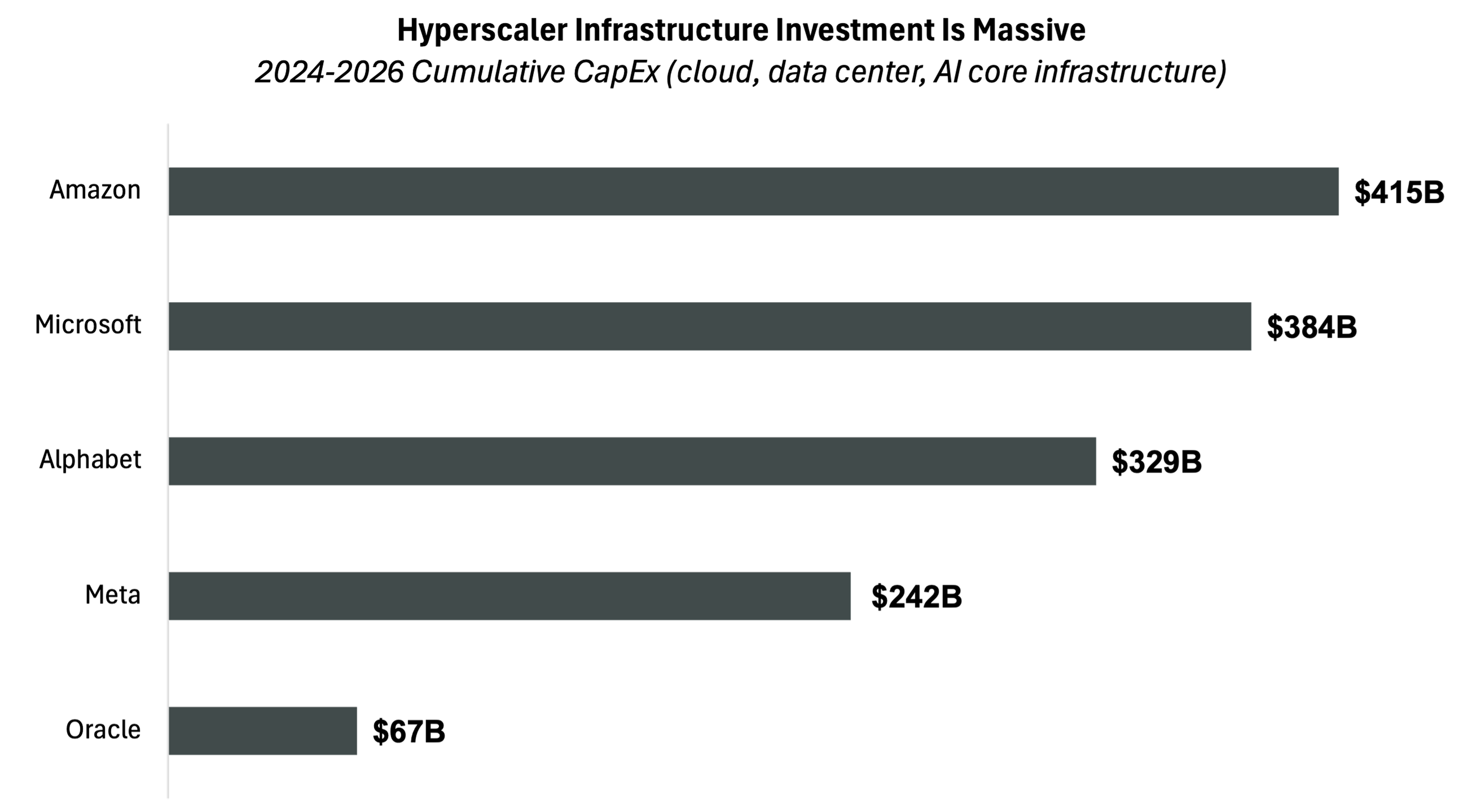
DeCicco: There's definitely been some opportunities created, but I continue to think that generative AI is the greatest investment opportunity for all of our strategies in the market right now. And that might be the case for the next five years. This started with really the infrastructure and the semiconductors for the data center build-out.

It's broadened into areas like software, as well as things related to the Internet, Internet advertising and is continuing to broaden beyond that in areas like financial services or retailing, where companies like JP Morgan and Walmart are talking about the ways in which they're seeing productivity gains from generative AI.

I think people tend to think that these big tech themes (or any big theme that you invest in the market), are overhyped, and sometimes that's the case. But with these really big transformative, secular, technological shifts, they often are underestimated.

This is what occurred with the Internet. Shortly after the Internet came about there were forecasts that there would be 150 million Internet users by the year 2000. That seemed impossible at the time. Well, it ended up that it was way too low.

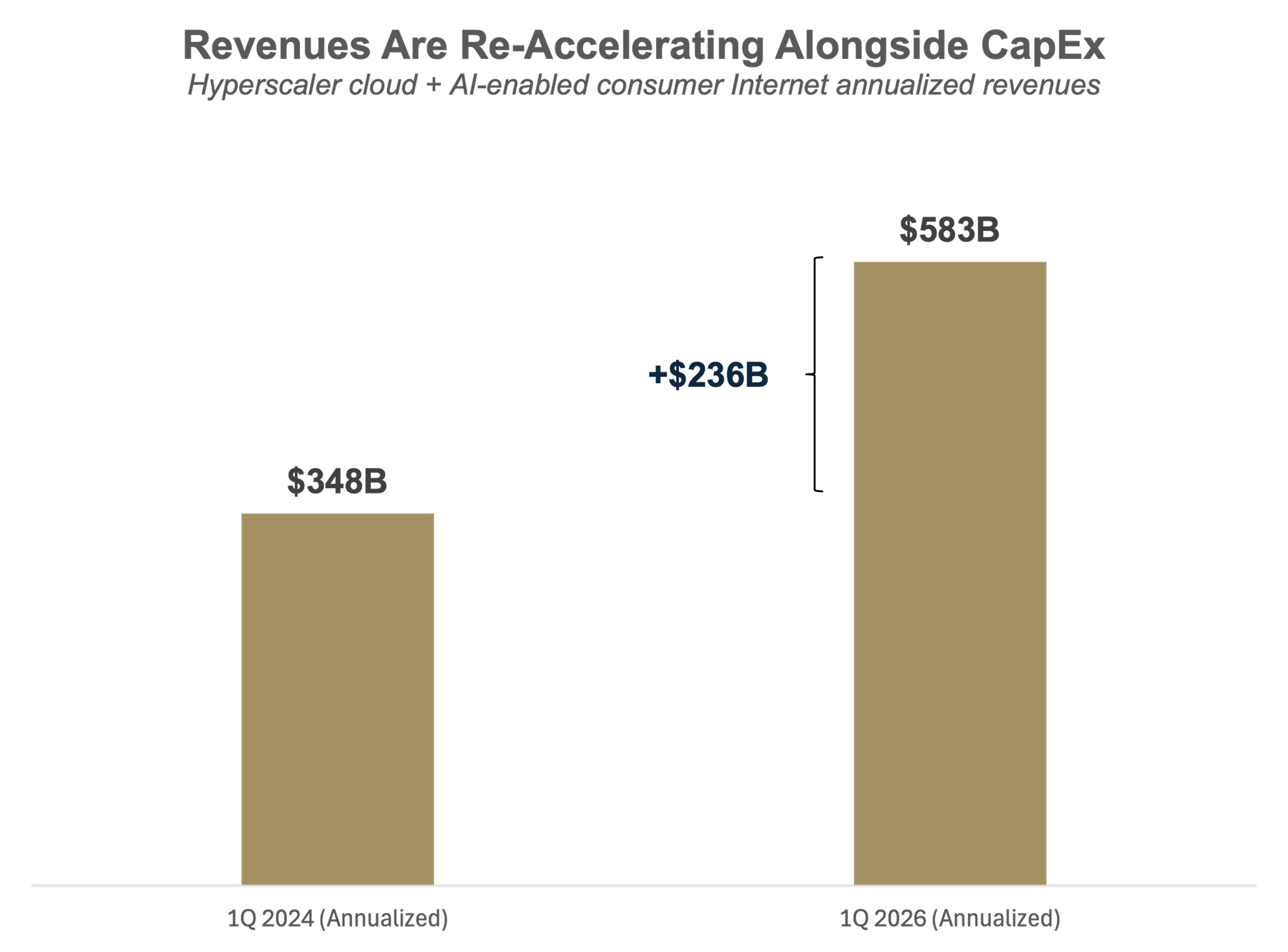
There were 350 million Internet users by the year 2000, and it mushroomed from there. Generative AI is going through the same type of underestimation phenomenon that we've seen with the Internet, PCs, cloud [computing], and the mobile [technology] boom. At the end of the last decade the estimates for artificial intelligence would be that it would do $125 billion in revenues in 2025.

That's going to be way too low. It's going to be probably $200 billion too low. And so, this remains an excellent opportunity because when you have this sort of underestimation there's companies that can create new revenue and earnings opportunities from an estimate being $200 billion of revenues that's underestimated, that's missed. [Internet usage and AI economic activity data based on Morgan Stanley research.]

But then there's also this dynamic of the new companies that are created that we can invest in. Just think of all the companies that have been created in the aftermath of the Internet boom in the last 20 years. We think the same type of opportunities are going to come out of generative AI.

And again, I want to reiterate that this maybe started two years ago very narrowly in semiconductors and the companies that helped build data centers, but it's broadening much beyond that. And so even if you're a value investor or somebody who doesn't spend a lot of time in technology, there are opportunities from the companies that are using these tools to become more productive that can make them have a competitive advantage. So, I think this is a productivity boom that we can exploit really across every sector of the economy.

D’Souza: So, it's pervasive across all sectors in the economy is what you're saying. And what if we cross borders now? Let's look outside the U.S. And I know you've been bullish on international equities. I think it's paid off pretty well, relatively speaking to the U.S. here recently. And then of course the tariff news, tariff talks and tariff volatility. How does that color your view on bullishness?

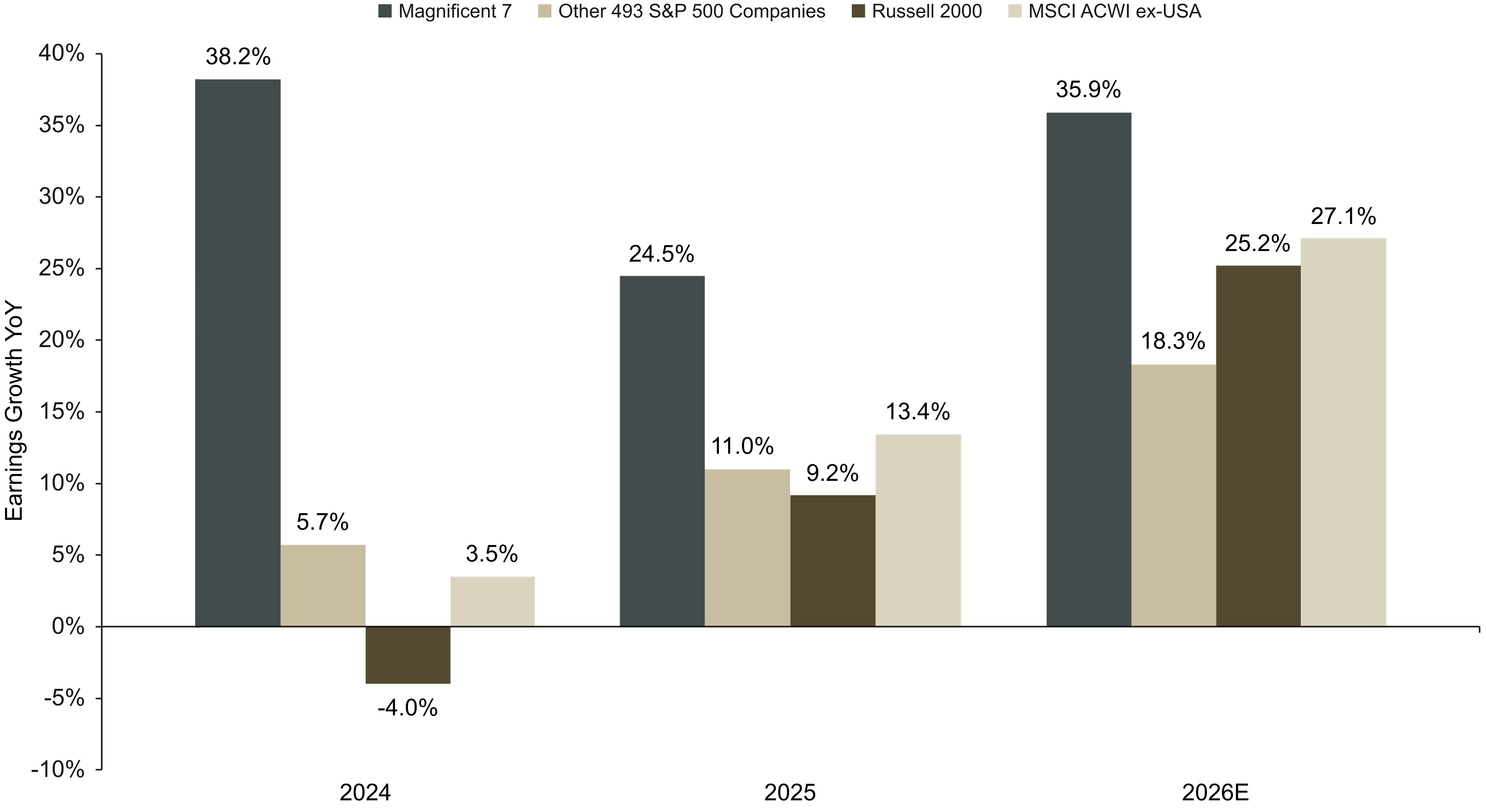
DeCicco: Yeah, I'm still optimistic about international equities. And the story really remains the same. There are two key elements to this. The first is that the growth differentials between the Magnificent Seven and the MSCI EAFE [Index], so developed markets, those differentials are going to narrow meaningfully. So, in 2024 roughly the Magnificent Seven grew its earnings by 35%, and the MSCI EAFE grew its earnings somewhere in the low single digits. Now, the Magnificent Seven will still grow its earnings at a very healthy clip, but that's decelerating meaningfully, probably to somewhere in the high teens this year in '25.

Meanwhile, earnings of companies outside the U.S. are accelerating, probably to somewhere in the high single digits. So, this big differential that existed in '23 and again especially in the first half of '24, we see that narrowing. And that happens at the time when the stocks are incredibly cheap historically, compared to U.S. stocks, call it a 30% discount what they've traded at historically.

So, I wouldn't buy stocks just on valuation alone. But you have the relative attractive valuation plus the growth differential that existed for the last few years is narrowing. I think there's other things related to policy that will play a role as well.

We do have the U.S. fiscal drag from tariffs, which again is probably less now than we thought it would be just a month ago but is still a fiscal drag, nonetheless. I do think that will be offset and so the U.S. will probably be fiscally, probably be in a neutral spot.

But you compare that to especially a place like Europe, where the ECB [European Central Bank] is easing, there's clear fiscal impulse, and so in the near term you also have some monetary and fiscal policy support for somewhere like Europe that maybe you don't have here in the U.S., where fiscal [policy] again might be neutral and the Fed [U.S. Federal Reserve] could be on hold for at least the next few months. I'm not in the camp, like some other people, that it's an either/or decision though. I think both can work. So, I think you want to allocate to non- U.S. equities, but I also think you want to have a healthy allocation to U.S. equities.

D’Souza: So, in summary, Matt, it feels like there's been increased volatility in the first part of the year, understatement of the year perhaps, but also a strong earning season so far. We're almost all the way through it. Some positive indicators as well, looking at longer term in the marketplace versus history.

High-quality companies are still important, and those are defined in different ways, but they are defined, what they mean and why they're important. Generative AI is still important as ever, if not more important as it broadens out across the market and the landscape.

It's pervasive across all industries and sectors and even across borders. And, speaking of across borders, despite the gyrations in all the tariff news and hype that's been out there, you still see strong valuations and opportunities outside the U.S. border. Is that a pretty good summary in your mind?

DeCicco: Well done. Yeah. Thank you.

D’Souza: Thank you very much. And thanks again for your time today, Matt. We appreciate the mid-year outlook with you. Looking forward to having you back real soon in the studio. But again, we appreciate it. Thank you.

DeCicco: Thanks for having me.

D’Souza: This has been The Investment Conversation podcast. Be sure to visit lordabbett.com to find our complete 2025 mid-year investment outlook, along with other market and economic insights. Thank you all for listening.