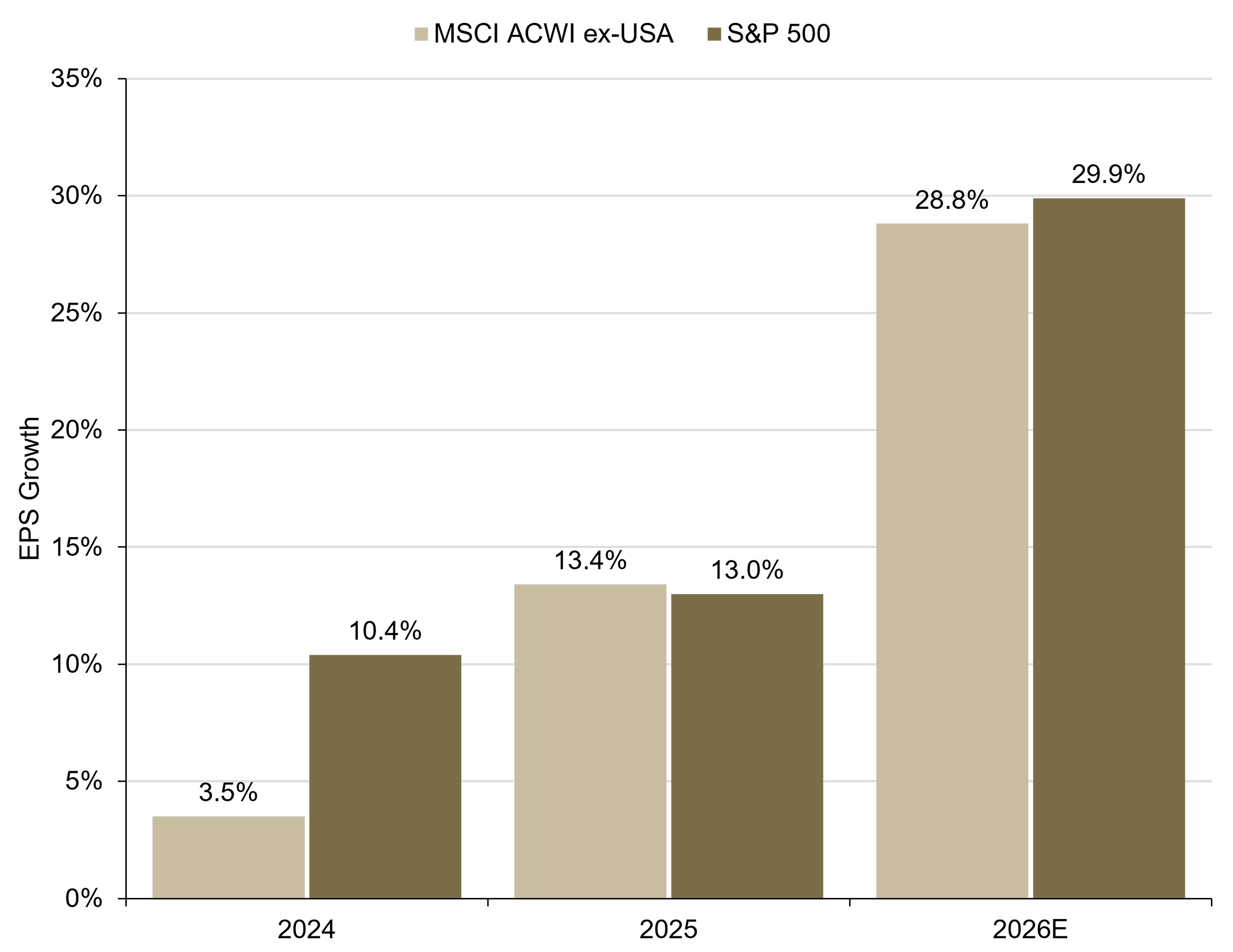
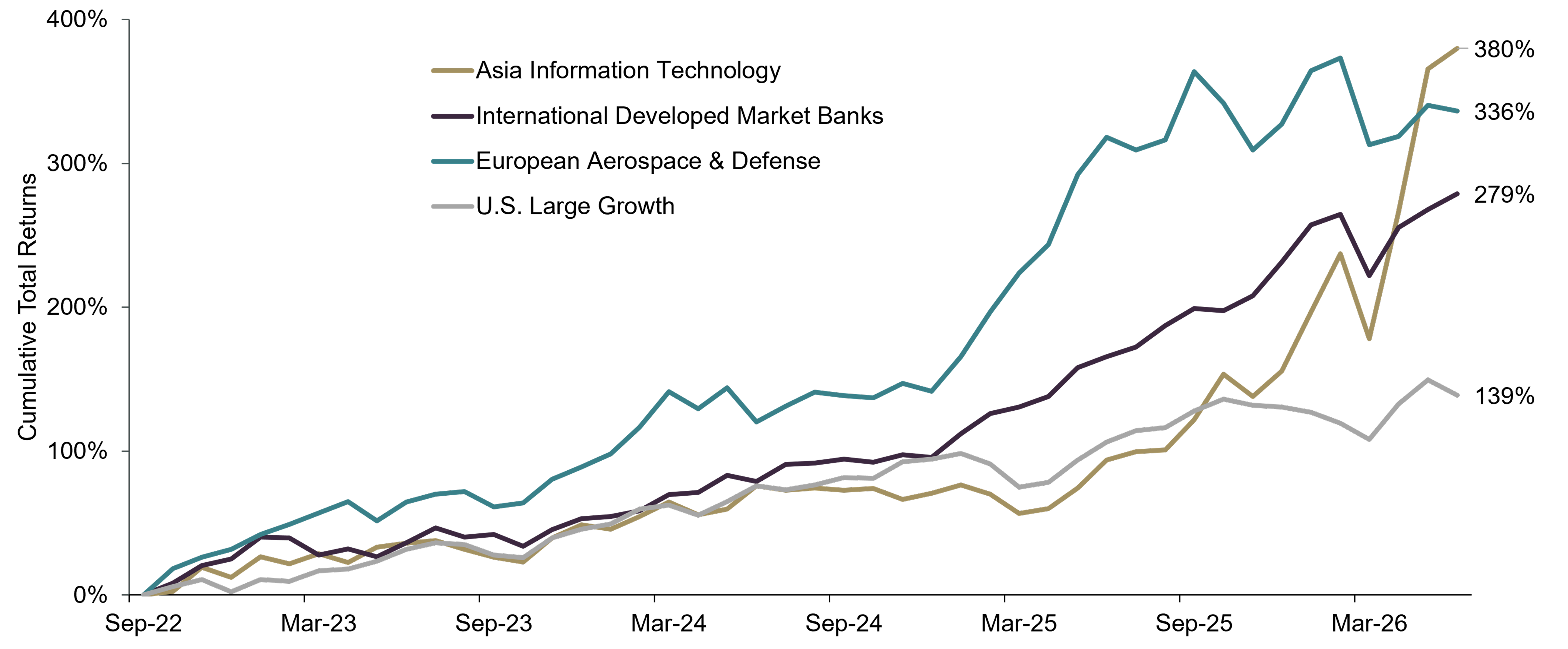
But
these tailwinds will not benefit every company equally. We believe what matters
is whether a business has the competitive strengths to translate growth into
sustained attractive returns. That is why we believe global investing
ultimately comes down to companies, not countries—and to one important
question: What makes this business difficult to compete with?
Strong
Results Are the Outcome, Not the Explanation
Strong
financial results can signal a quality business, but they do not explain why
that strength can endure. Sustainable competitive advantages can allow a
company to earn attractive returns on capital and reinvest at similarly
attractive rates—supporting future growth and compounding value over time. Profit margins, capital
efficiency, and free cash flow can provide evidence of that strength, but they
describe what a company has achieved, not why those results exist or whether
they can endure.
Consider two companies
with similarly attractive results. One faces easy competition; the other is
protected by brand, scale, technology, or network effects. The numbers may be
similar, but their durability may not. The key is understanding what protects
those returns—and for how long.
Three Key Forms of Competitive
Advantage
Strong brands or
differentiated products can be powerful, but they are only part of the picture.
We seek companies with sustainable competitive advantages that we believe fall
into three areas: consumer, producer, and network advantages.
- Consumer
Advantage
A consumer advantage exists when a company offers something customers value that competitors have difficulty replicating. A powerful luxury brand, for example, can command a premium because its reputation, heritage, or scarcity cannot easily be recreated. The advantage can also be less obvious. With a mission-critical product such as an aircraft engine, the high cost of failure makes technical expertise, safety performance, certifications, and customer trust particularly valuable. In both cases, differentiation can support customer loyalty and pricing power.
- Producer Advantage
A producer advantage comes from how efficiently or effectively a company operates. A large retailer may buy at volumes that allow it to negotiate better terms than smaller competitors and spread costs across a larger sales base. The product may not be unique; the advantage lies in the economics of how it reaches the customer. In advanced semiconductor manufacturing, enormous research investment, complex production capabilities, and specialized know-how can create a reinforcing cycle: leadership can support market share and cash generation, which can fund further investment to extend the lead. Basic industries could also benefit. Construction aggregates are expensive to transport over long distances, so control of strategically located resources can limit local competition. The common thread is not necessarily high margins, but an operating model that allows the business to use capital more efficiently than competitors.
- Network Advantage
A network advantage
arises when a product or service becomes more valuable as more people use it.
In ride-sharing, more riders can attract drivers, while more drivers can improve
availability for riders. As participation grows, the service can become more
useful to both—creating a self-reinforcing advantage that may be difficult for
a smaller competitor to replicate.
Across all three forms,
the principle is the same: there is a structural reason competitors may
struggle to reproduce the company’s economics.
Why That Matters Even
More Today
The same forces
creating new opportunities are also reshaping competitive advantages—and the
earnings potential of industries investors may have overlooked.
For example, the first
wave of AI data-center investment was concentrated around advanced processors
and the systems directly supporting them. As spending has grown and suppliers
have approached capacity, demand has spread further through the supply chain, from
memory and cooling systems to electrical components, power equipment, and
optical connectivity. Some of these businesses have traditionally been viewed
as cyclical suppliers rather than long-term growth companies. However, tightening
capacity, rising utilization, and stronger demand are improving pricing and
earnings potential in parts of the supply chain. In some cases, AI investment has
been giving “new life to old tech,” creating a new earnings cycle for
businesses that historically received far less investor attention.
A powerful secular
tailwind does not automatically create a sustainable competitive advantage. The
key is determining which companies have something that allows them to capture
and retain those improved economics—whether through scale, scarce capacity, specialized
expertise, process complexity, or another structural advantage.
Innovation can also
work in opposite directions. In some areas of software, AI may reduce
historically high switching costs by making functionality easier to recreate or
migrate. For a large distribution business, AI could have the opposite effect.
A company with an established network and years of operating data may be able
to use AI to improve routing, forecast demand, and lower costs in ways smaller
competitors struggle to match. In one case, innovation can weaken an existing
advantage. In another, it can make that advantage even stronger. Elsewhere, it can
create an entirely new earnings opportunity. For active investors, the
challenge is distinguishing between exposure to a powerful secular trend and
the competitive advantage needed to turn that opportunity into sustained
attractive returns.
Summing Up
Global markets are
offering investors a broader set of opportunities, but the strongest businesses
are not defined by where they are headquartered. They are defined by what makes
them difficult to compete with. As AI, infrastructure investment, industrial
expansion, and other secular forces reshape industries, competitive advantages
will evolve with them.
That makes active,
bottom-up research increasingly important: looking beyond geography and
headline growth to identify companies with the pricing power, scale, expertise,
networks, or other structural strengths to convert opportunity into durable
value.
At Lord Abbett, our
approach begins with the individual company: understanding the sources of its
competitive advantage, assessing how durable those advantages can be, and
determining whether the business can translate them into attractive returns on
capital and opportunities to reinvest for future growth.