September Fed Meeting: From Signals to Action

The latest FOMC policy decision could provide important clues about whether the rate hike represents a one-time adjustment or the beginning of a higher path for interest rates.

This is a marketing communication.

The Federal Reserve raised the target range for the federal funds rate by 25 basis points at its September meeting, marking the first increase since July 2023. But with markets increasingly anticipating the hike heading into the meeting, the decision itself may be less important than what policymakers signal about what comes next.

Is September the start of a hiking cycle or a one-time adjustment?

We do not view this as the start of an extended hiking cycle. The Fed characterized the move as supporting a “timelier” return to its 2% inflation goal, suggesting that the path from here will depend largely on the evolution of underlying inflation.

While Chair Warsh provided little explicit forward guidance, the updated projections offer some insight into how other FOMC participants see the path ahead. The median projection points to one additional 25-basis-point hike by year-end, followed by no further increase in 2027, although there remains meaningful dispersion among individual participants.

Markets are pricing a more aggressive path. Fed funds futures currently imply roughly three additional 25-basis-point hikes over the next year, according to Bloomberg—considerably more tightening than suggested by the median FOMC projection. That gap between market pricing and policymakers’ projections will be important to watch as incoming inflation data shape expectations for the path of rates.

What does the new dot plot tell us about the dispersion of views within the FOMC?

The September dot plot includes projections from 18 participants, as Chair Warsh continues to refrain from submitting his own forecast. While the median projection points to one additional 25-basis-point hike this year, four participants see two additional hikes as appropriate.

The range of views widens considerably beginning in 2027, with participants divided between rate cuts, holding policy steady, and further tightening. That dispersion highlights the uncertainty around the path of policy beyond the next several meetings. Also notable, the median longer-run federal funds rate edged higher to 3.25%, from 3.1% in June.

We believe, however, that the dot plot may carry less signaling power under a Warsh-led Fed. Given Chair Warsh’s skepticism about the usefulness of individual rate projections—and his decision not to submit one—the dots may be better viewed as a measure of the range of views within the FOMC than as explicit guidance about the future path of rates.
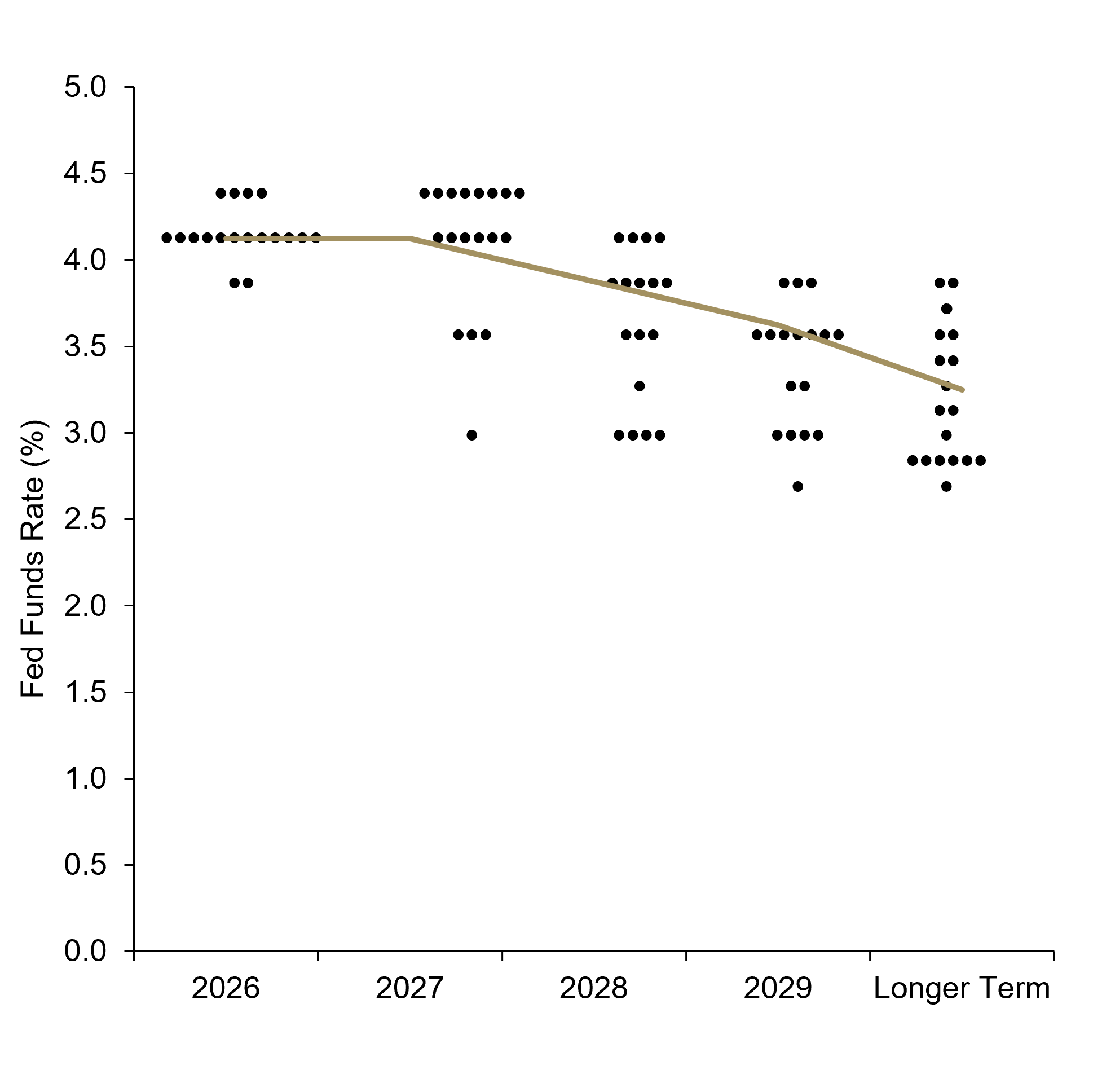
 

Figure 1. Fed Dot Plot Suggests a Range of Views and Potential Outcomes

Line chart showing the projected federal funds rate remaining at 4.1% in 2026 and 2027, then declining to 3.9% in 2028, 3.6% in 2029, and 3.2% in the longer term.

Source: U.S. Federal Reserve. Data as of September 16, 2026. The Fed’s dot plot shows where each Fed official expects interest rates to be in the future. Each dot represents one official’s projection. For illustrative purposes only and does not represent any specific portfolio managed by Lord Abbett or any particular investment.

How is the Fed assessing the economic outlook?

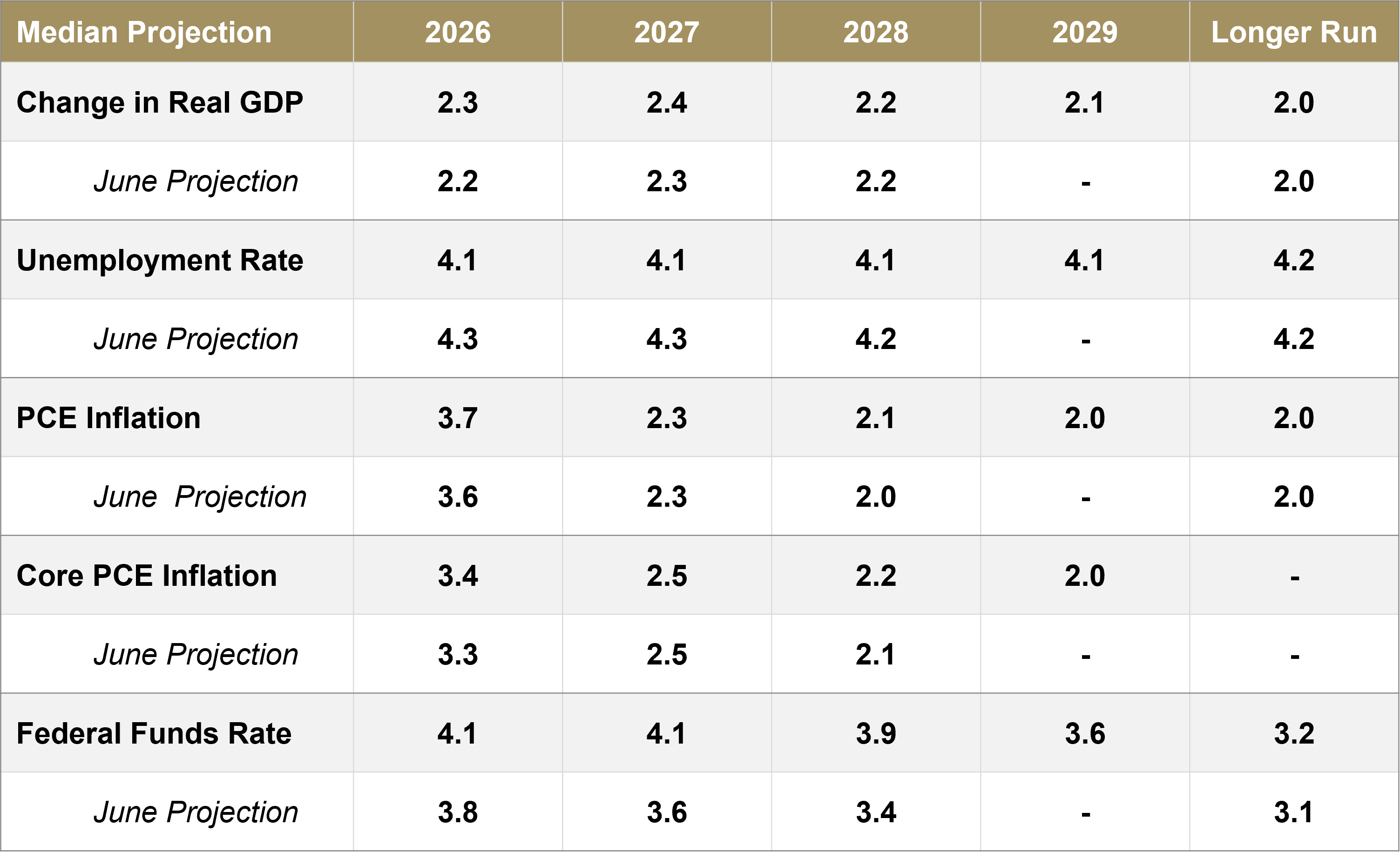
The September projections point to stronger growth, lower unemployment, and slightly higher inflation than the Fed projected in June. That is broadly consistent with the resilience we have seen in the labor market and consumer spending in recent months.

The projections suggest an economy that remains strong enough to absorb some additional policy tightening, while inflation continues to warrant the Fed’s attention. At the same time, the outlook does not appear to point to the need for a prolonged hiking cycle, particularly if underlying inflation begins to moderate.
 

Figure 2. A View of the Fed’s Summary of Economic Projections 

Table comparing the Federal Reserve’s September median economic projections with June projections, showing slightly stronger GDP growth, lower unemployment, modestly higher inflation, and a higher federal funds rate path through 2029 and the longer run.

Source: U.S. Federal Reserve. Data as of September 16, 2026. The Summary of Economic Projections (SEP) is a report published by the Federal Reserve that provides FOMC participants’ forecasts for key economic variables over the next several years and the longer run. For illustrative purposes only and does not represent any specific portfolio managed by Lord Abbett or any particular investment.

What did we learn about inflation?

Warsh’s comments in the press conference were very consistent with the message he delivered in his speech in Jackson Hole on August 28. The underlying trend in inflation has not shown sufficient improvement yet. He acknowledged that the geopolitical events that are causing energy prices to increase have not been helpful. However, by removing the reference to supply shocks in the statement, the Committee signaled that they will not use energy prices as an excuse not to raise rates. Inflation remains elevated – period.

Is Fed communication actually changing?

The shift in Fed communication under Chair Warsh is becoming more apparent. The policy statement remained brief and focused on the key information, while the press conference was among the shortest in recent years—roughly 15 minutes shorter than average. The overall approach was direct and succinct, consistent with Warsh’s preference for a quieter Fed.

Warsh also continues to step away from some of the tools traditionally used to guide market expectations. He did not contribute a projection to the Fed’s Summary of Economic Projections (SEP) and reiterated that he will not provide explicit forward guidance. Instead, he said policy continues to be guided by the key principles he outlined at Jackson Hole, although he did not elaborate on them at the press conference.

What does it mean for Geefixed income investors?

Treasury yields have already moved higher to reflect the expectation that the Fed was going to hike rates. The market is currently pricing in more hikes than are expected by Fed officials, so it is likely that yields are currently at the top end of the range. Furthermore, by hiking rates now, the Fed is signaling its commitment to price stability and conducting an orthodox monetary policy. This should be supportive for longer-maturity Treasuries and for risk assets overall. Higher rate volatility due to less forward guidance and increased geopolitical uncertainty means more dispersion in returns across fixed income sectors and industries. We continue to believe this environment favors diversified, actively managed multi-sector portfolios.