Available as a podcast: Listen to the related episode of The Investment Conversation.
This is a marketing communication.
Leveraged Finance Has Expanded and Evolved
Public and private credit markets have expanded significantly over the past 15 years, supported by investor demand for income, floating-rate exposure, and access to leveraged credit. High yield bonds, BSLs, and private credit have each grown into substantial segments of the leveraged finance market, with private credit experiencing the most pronounced increase. That growth has reflected several reinforcing trends: a prolonged demand for yield, the increased use of floating-rate debt in changing interest-rate environments, and a broader shift by corporate borrowers toward non-bank and capital markets financing.
Figure 1. Private Credit Has Led the Growth of the Leveraged Finance Market
Assets by market for the indicated years
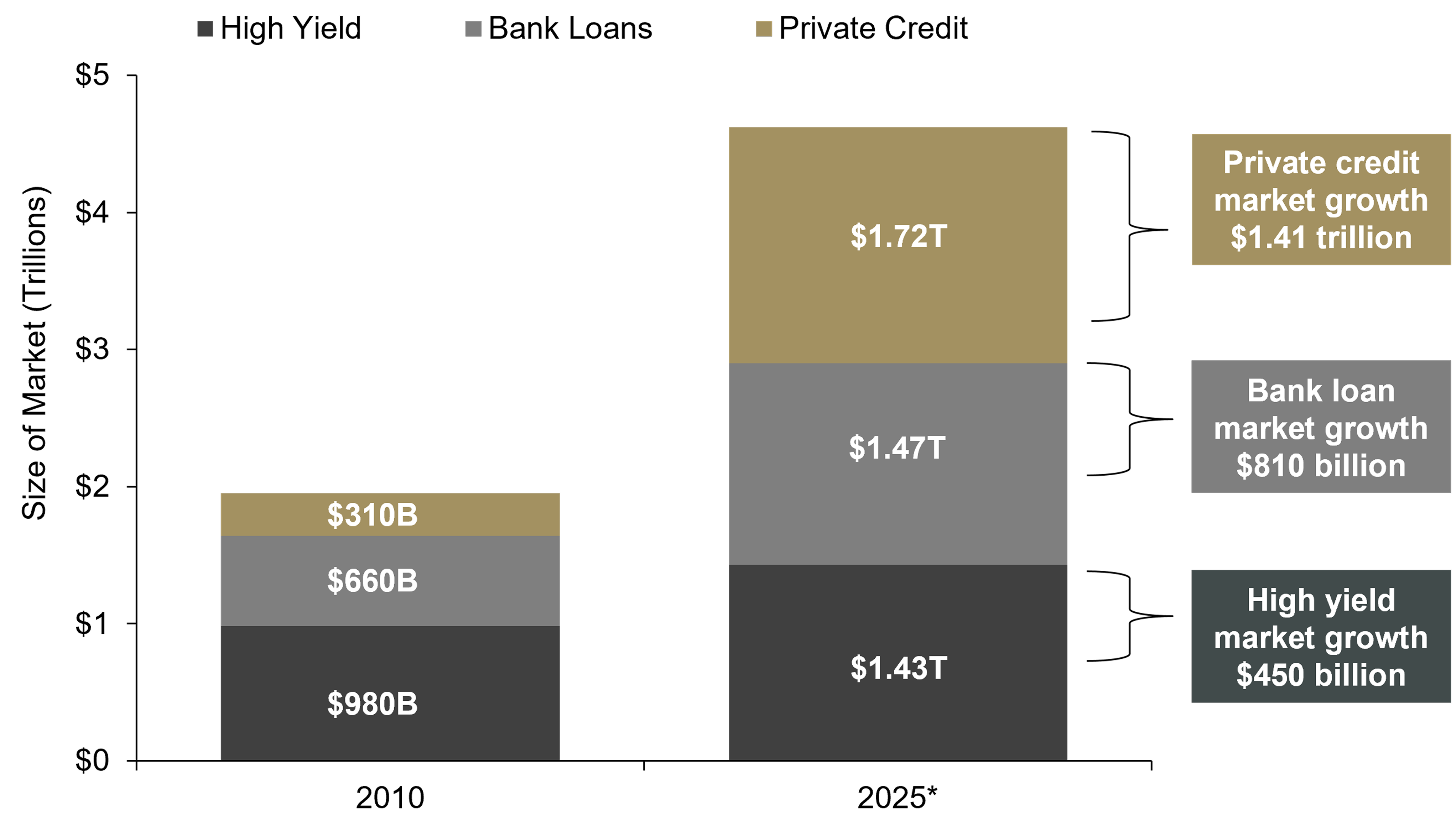
Source: Preqin and PitchBook. *2025 data as of March 31, 2025. For illustrative purposes only and does not represent any specific portfolio managed by Lord Abbett or any particular investment.
These trends have been reinforced by a fundamental shift in the financing landscape. Bank consolidation and post-global financial crisis (GFC) regulations reduced the availability of traditional bank lending, particularly for middle-market companies, while periods of public market volatility prompted more borrowers to seek capital from private lenders. These dynamics have helped establish private credit as an increasingly important source of corporate financing.
Broader Financing Options for Borrowers
But market growth alone does not explain the current environment. The more relevant development has been the degree to which these markets now intersect. As private credit, BSLs, and high yield have expanded, borrowers have gained more ways to evaluate financing alternatives across the leveraged credit spectrum. They can now compare markets based on trade-offs among cost, speed, execution certainty, flexibility, liquidity, scale, confidentiality, pre-committed capital, and structural terms.
- Cost: The economics of the financing, including coupon, fees, call protection, and any premium paid for greater certainty or flexibility.
- Speed: The time required to secure financing, complete diligence, and close the transaction, particularly when timing is important for an acquisition or strategic initiative.
- Execution certainty: The confidence that financing will be available on agreed terms, without meaningful market disruption, syndication risk, or execution delays.
- Flexibility: The borrower’s ability to tailor terms around business needs, including acquisition financing, delayed-draw capacity, prepayment options, and documentation provisions.
- Liquidity: The degree to which financing can access a broad investor base and support secondary-market trading, which can be more relevant in broadly syndicated loans and high yield.
- Scale: The ability of a market to provide sufficient capital for larger transactions, including refinancings, acquisitions, or multi-year strategic plans.
- Confidentiality: The extent to which a borrower can limit public disclosure of financial information, business strategy, or transaction details.
- Pre-committed capital: The ability to secure additional capital in advance to support business needs such as potential acquisitions and growth capital expenditure programs.
- Structural terms: The covenants, leverage levels, collateral package, maturity profile, prepayment features, and lender protections that define the overall terms of the financing.
Borrowers with sufficient scale have been increasingly comparing these trade-offs, at times using more than one market within the same financing strategy. In a converging market, the main question is not which financing channel is available, but which structure best fits the borrower’s objectives.
The Investment Manager’s View of a Connected Credit Market
From an investment manager’s perspective, convergence can create both a broader opportunity set and a more complex underwriting environment. As borrowers move more easily across financing channels, managers need to evaluate not only the credit quality of the borrower, but also how a proposed financing compares with other available sources of capital, and whether the structure provides adequate compensation for the risk.
A more connected market can also offer a robust information set. Public credit markets can provide timely signals on pricing, liquidity, sector and borrower-specific fundamentals, and general investor sentiment, while private credit offers deeper access to borrowers, industry information, sponsors, management, and negotiated transaction details. For managers with capabilities across both markets, those insights can be used together to assess relative value, separate technical market movements from fundamental credit indicators, and maintain discipline when competition for transactions increases. Full visibility across the entire leveraged credit ecosystem and sharing data and insights from both markets can help managers become more astute investors.
The Core Middle Market: Where Convergence Has Limits
The convergence of public and private credit has expanded financing options for many borrowers, but not all of them. While larger companies increasingly move between syndicated loans, high yield bonds, and private credit based on market conditions, most core middle-market companies don't have that luxury. Limited scale and access to the public markets often make private credit their primary source of capital.
For investors, that distinction matters. Because borrowers have fewer financing alternatives, experienced lenders can spend more time underwriting businesses, negotiating financing terms directly, and structuring loans with stronger lender protections. The result is an opportunity set that tends to be driven less by public market technicals and more by manager skill in sourcing, underwriting, and portfolio management. In other words, while convergence is changing much of the credit landscape, the core middle market remains an area where active lending relationships and disciplined credit selection can still create meaningful differentiation.
Figure 2. A Borrower-Size View of Private Credit Trade-offs
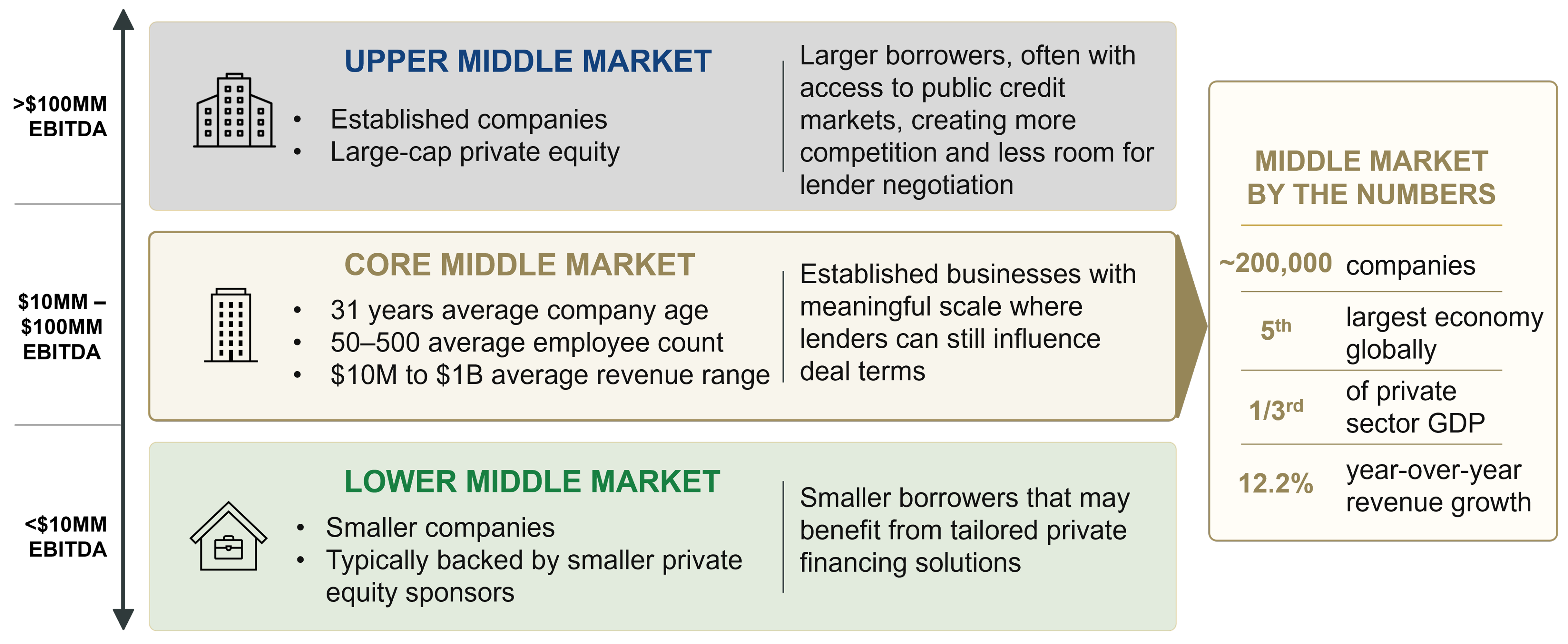
Source: Lord Abbett; National Center for the Middle Market (NCMM), Middle Market Indicator Year-End 2025 and historical data through Q4 2025. Data as of December 31, 2025. Most recent data available. The Middle Market Indicator (MMI) is a survey-based economic gauge of U.S. middle-market companies, typically defined as companies with $10 million to $1 billion in annual revenue. Revenue cohorts reflect NCMM definitions, not earnings before interest, taxes, depreciation, and amortization (EBITDA). NCMM core middle market is defined by revenue ($50M to <$100M). The historical data are for illustrative purposes only and do not depict or predict the performance of any specific portfolio managed by Lord Abbett or any particular investment. Indexes are unmanaged, do not reflect the deduction of fees or expenses, and are not available for direct investment.
Summing Up
The distinction between public and private credit is becoming less about competing asset classes and more about complementary tools within a broader credit allocation. As borrowers move more fluidly between financing channels, understanding relative value, borrower fundamentals, and market dynamics across both markets becomes increasingly important.
For investors, that has meaningful implications. Private credit can provide access to negotiated structures, direct origination, and the potential for an illiquidity premium, while public credit offers liquidity, price transparency, and the flexibility to reposition portfolios as market conditions evolve. Each serves a different role, and each brings distinct advantages.
Rather than choosing one market over the other, investors may benefit from thinking about how the two can work together. Managers with experience across both public and private credit may be better positioned to evaluate opportunities, identify relative value, and build portfolios that seek to generate attractive income while managing risk across changing market environments.