Dividend Growers: The Importance of Yield-on-Cost

While current yield is a key consideration, we think it’s essential to focus on the potential future income of an investment in dividend-paying stocks.

This is a marketing communication.

When researching dividend-paying stocks, investors often focus on the current dividend yield—the rate of payout their investment is generating now. This is understandable, as a typical goal of a dividend-focused investor is to generate current income. But only paying attention to the current yield misses out on what we believe is the real power of dividends: the potential growth of future income from your investment. For dividend stocks, we think this concept is best illustrated by a metric known as yield-on-cost, which we believe has several strategic advantages over merely focusing on current yield.

Yield-on-cost is calculated by dividing the annual dividend income by the original purchase price of the investment. This measure reflects how much an investor is earning from their initial investment over time. Looking through this lens can help illustrate the potential for the long-term growth in income from dividend-paying stocks.

Rising Dividends, Rising Income

A good way to visualize this concept is to examine the income generated over time by an initial investment of $10,000 in the S&P 500® Index and the S&P 500® Dividend Aristocrats Index®, which measures the performance of S&P 500 companies that have increased dividends every year for the last 25 consecutive years (see Figure 1). Taken by itself, the initial yield on both indexes in 1989 is not an eye-popping figure compared to the yields available on other asset classes at that time. This is where a long-term focus and the power of growing dividends become important. Over time, the strong dividend growth of those S&P 500 Aristocrats led to an income stream more than twice as large as its broader counterpart (as the chart assumes that dividends are being withdrawn each year).
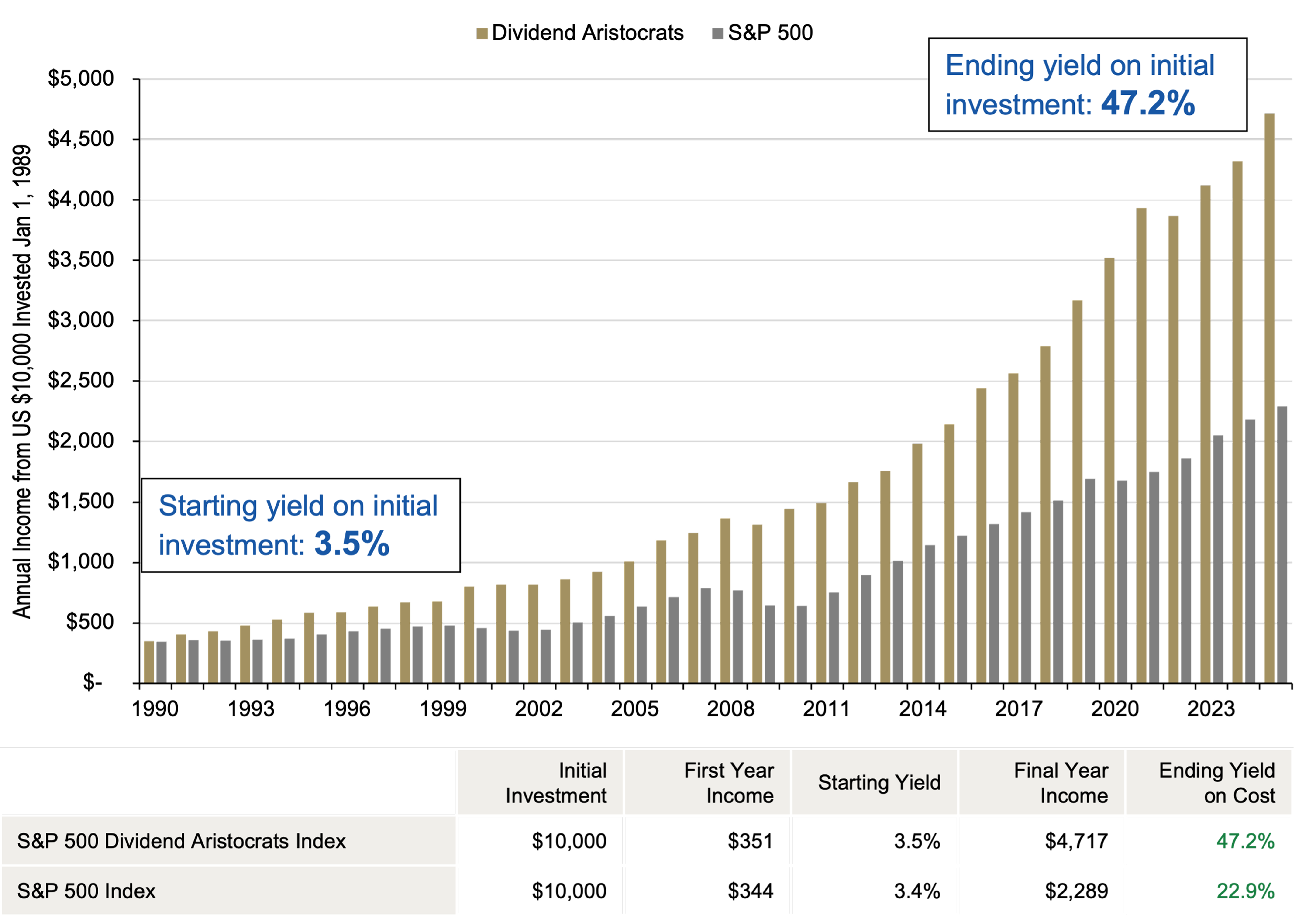
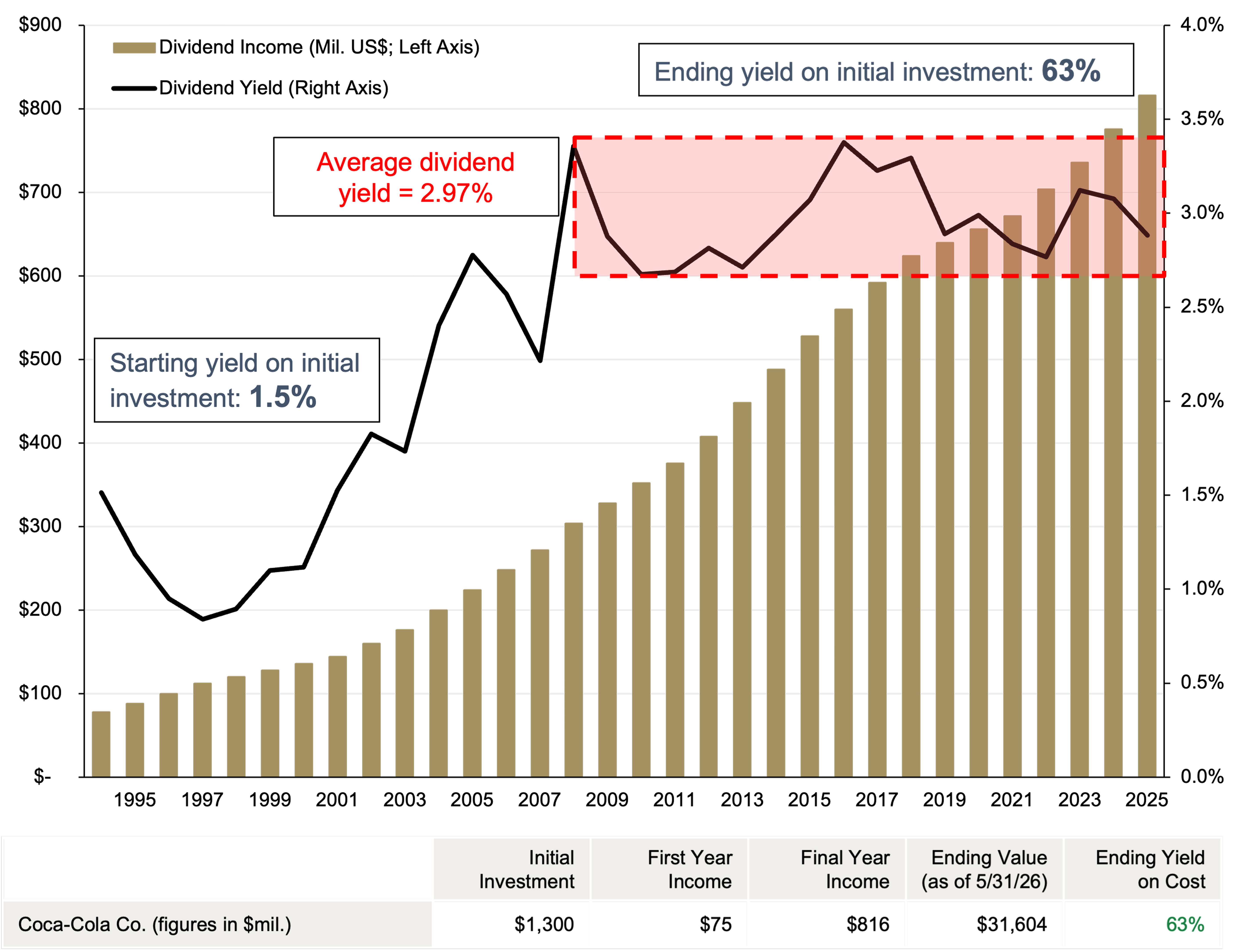
Figure 1. Yield-on-Cost Provides a Compelling Illustration of the Power of Dividend Growth

Annual dividend income on $10,000 invested on January 1, 1989 (1989–2025) for the S&P 500® Index and the S&P 500® Dividend Aristocrats Index®

Bar chart comparing annual income from a $10,000 investment in the S&P 500 Dividend Aristocrats Index versus the S&P 500 Index from 1990 to 2025, showing income growing to $4,717 versus $2,289 and resulting in ending yields on cost of 47.2% and 22.9%, respectively.
Source: FactSet. Data as of December 31, 2025. Most recent full-year data available. A company's dividend payments may vary over time, and there is no guarantee that a company will pay a dividend at all. Past performance is not a reliable indicator or guarantee of future results. For illustrative purposes only and does not represent any specific portfolio managed by Lord Abbett or any particular investment. Indexes are unmanaged, do not reflect the deduction of fees and expenses, and are not available for direct investment.

It is important to note that over this time horizon, the dividend yield on both indices has decreased. The average dividend yield over the entire period of the S&P 500 was 1.8%, while the Dividend Aristocrats was 2.5%. But if we focus on yield-on-cost, we see that our initial investment in the stock market is yielding almost 50% when targeting companies with a focus on dividend growth.

The experience of one of the most well-known investors of our time, Warren Buffett, underscores the importance of yield-on-cost. In 1994, Buffett's company, Berkshire Hathaway, completed a seven-year purchase of Coca-Cola shares for $1.3 billion. The cash dividends from that investment produced $75 million of income for Berkshire in 1994. As of this writing, Coke's current yield is around 3% and has been for the last 17 years (see Figure 2). While some may see the unchanged yield as a detriment, the annual dividend has grown 268%, while the stock price appreciated by 209% over this period. As a result, those cash payouts grew to $816 million by 2025, resulting in a yield of 63% on the initial investment. Should the soft-drink giant continue its multi-decade run of sustainable growth and annual dividend hikes, the yield on cost will continue to increase as well. The key takeaway here is that for long-term investors in companies that grow their dividends over time, the starting yield is not as relevant as the ultimate yield on cost of that investment.

Figure 2. Dividend Increases Fueled Rising Income from Coke Shares Even as Yield Remained in a Narrow Range

Berkshire Hathaway’s annual dividend income from its mid-1990s Coca-Cola investment (left axis) and Coca-Cola’s dividend yield over time (right axis), 1994–2025

Bar and line chart showing Coca-Colas dividend income rising from $75 million on a $1,300 investment to $816 million between 1994 and 2025, with dividend yield increasing from 1.5% to a 63% yield on cost depsite annual yields averaging about 3%.
Source: FactSet. Latest available calendar-year data. A company's dividend payments may vary over time, and there is no guarantee that a company will pay a dividend at all. Past performance is not a reliable indicator or guarantee of future results. For illustrative purposes only and does not represent any specific portfolio managed by Lord Abbett or any particular investment. Indexes are unmanaged, do not reflect the deduction of fees and expenses, and are not available for direct investment.

Quality Counts

The Coke example highlights the importance of finding quality companies within the realm of dividend-paying stocks. Within that cohort, we believe investors can benefit by focusing on companies with a long history of dividend growth. These companies typically have stable earnings, robust cash flows, and a disciplined approach to returning capital to shareholders. This focus naturally aligns with selecting quality stocks that can sustain and grow their dividends over time, reducing the risk of income instability. As we noted in a previous article on dividend-growth investing, over the period from January 1973 through December 2025, dividend growers in the S&P 500 generated higher annualized returns with lower volatility than dividend payers that did not grow dividends, dividend non-payers, and dividend cutters.

Additional Insights on Dividend-Growth Investing

Dividend Growth Investing: A Focus on Flexibility and Selectivity

In contrast, a focus on current yield may lead investors toward higher-yielding, but potentially riskier, companies. Research has shown that the companies with the highest dividend yields have historically lagged the broader universe of dividend-paying stocks. These companies can face high volatility dealing with challenges maintaining its dividend or can have limited equity market participation as “bond proxies” (securities in sectors like real estate, utilities, and consumer staples that have high valuations with relatively low earnings growth). In addition, these “bond proxies” tend to be very interest-rate sensitive and can face headwinds during periods of rate volatility.

We think the potential long-term benefits of dividend-paying stocks are clear. However, we believe a thoughtful, active approach to dividend investing is vital to accessing these benefits while balancing risk and reward. We believe it is important to target quality companies that are not only willing to increase their dividend but are also able to do so in a manner that keeps their future growth intact. We have previously noted that an additional appealing feature of dividend-growth stocks is their lower volatility when compared to the overall dividend-paying universe. The outcome of owning a lower-volatility portfolio of dividend-growth companies may mean not only superior risk-adjusted returns over time, but the chance for investors to grow their wealth over the long term—and provide themselves with a more assured financial future.