This is a marketing communication.

Key Takeaways:

  • AI’s initial build-out phase may be disruptive as companies expend substantial capital to gain a strong competitive position.
  • Software that can effectively harness AI’s potential to improve productivity could provide future investment possibilities in the second phase of AI’s development.
  • We remain focused on generative AI as a long-term investment theme across equity strategies and are vigilant of the potential risks as innovations emerge.

It has been just under two years since the artificial intelligence company, OpenAI, rocked the technology world with its initial demonstration and launch of ChatGPT. Here, we reflect upon the progress made in the generative AI domain, imagine what might be to come, and discuss the potential investment opportunities within what we believe are the three phases of AI’s transformative impact.

The Three Phases of Generative AI

Phase 1. Capital Investment

Since the release of ChatGPT, technology has undergone numerous iterations, and new competitors have emerged. We firmly believe we are still in the first phase of generative AI industry build-out (see Figure 1), which is characterized by the development of necessary infrastructure to support the substantial computational power required for advanced AI applications. This infrastructure development is primarily occurring within data centers, which, from a market perspective, has been a tailwind for semiconductor and industrial stocks that are levered to the electrification, cooling, and engineering services necessary for scaling this new technology.

At this stage, the capital expenditures into accelerated computing have yielded material incremental improvements in computational power, which leads us to believe further investments are likely. This creates an incentive for the established hyperscalers—large technology companies that can provide scalable cloud and storage resources— to invest to out-compete each other and to stave off competition from well-funded upstarts. A technology shift like this will likely be very disruptive, and the stakes for success or failure are extremely high.

Phase 2. Software Development

We believe the next phase of generative AI will be the development of applications that enhance revenue and productivity. Already, we are seeing green shoots of these applications in areas such as coding efficiency, vertical software solutions, customer service automation, digital advertising, and in information technology (IT) support, to name a few. Companies that develop these applications will be fertile ground for new potential investment opportunities.

Phase 3. Broad-Based Deployment

The third phase will be when these tools are universally available, and investment opportunities will be influenced by the management teams and companies that can deploy these tools to change the revenues, earnings, free cash flows, and return on invested capital of their respective companies. As noted above, we believe we are still in the first phase of this market developing, and we are excited to see what will occur in the future. This may take years or decades to play out.
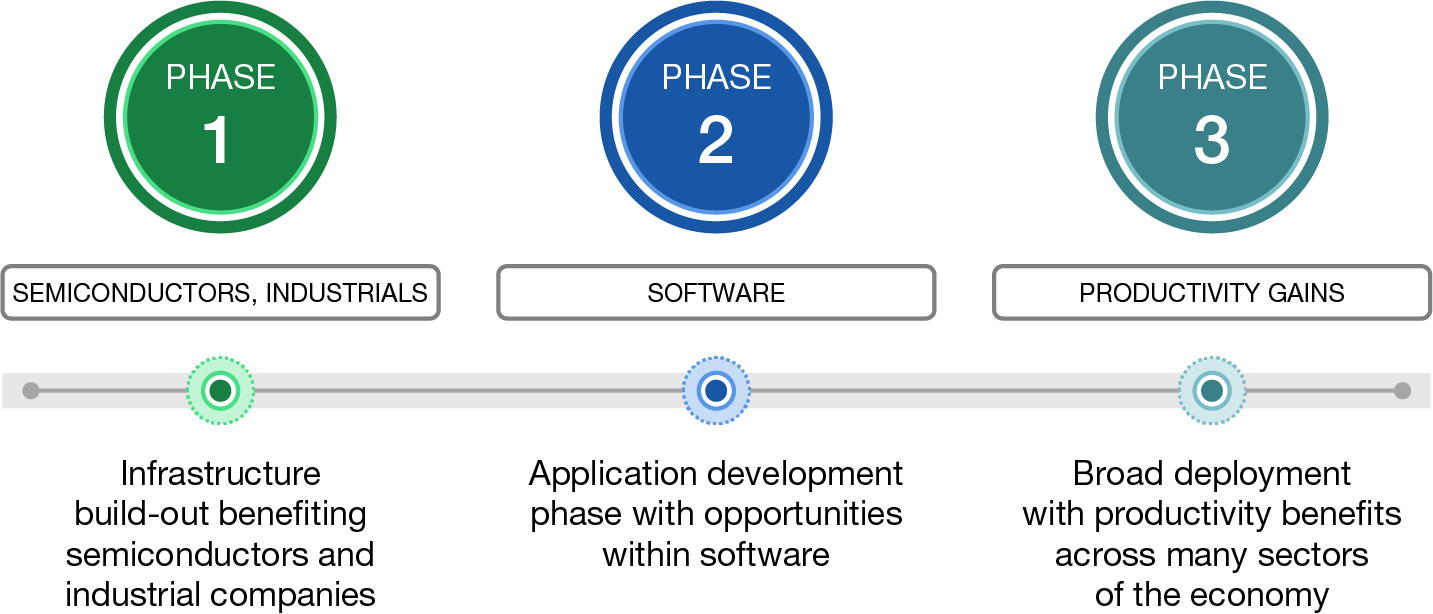
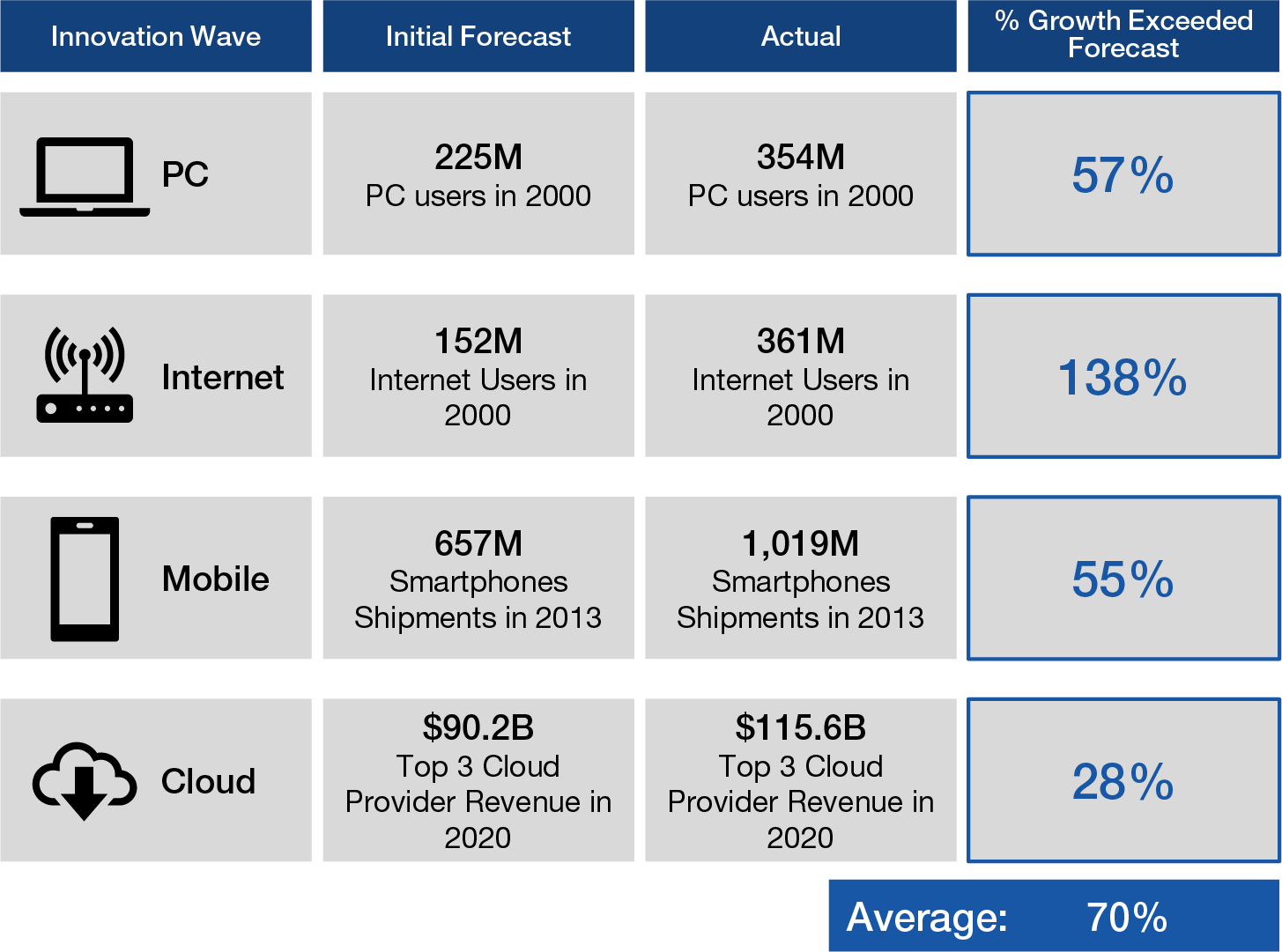
Figure 1. Investment Opportunities Across the Three Phases of Generative AI’s Buildout

Figure 1
Source: Lord Abbett. The information shown in the chart above is for illustrative purposes only and does not represent any specific portfolio managed by Lord Abbett.

Of course, forecasting is difficult, and we must humbly accept that we may not be able to imagine what unexpected new innovations will come to be. Therefore, our forecasts will be subject to revision as new data emerge.

Nearing the two-year anniversary of ChatGPT, it is imperative to realize that breakthrough innovation is systematically underestimated. In the past forty years, the personal computer, the Internet, the smart phone, and cloud computing arrived on the scene with great fanfare, yet still dramatically exceeded consensus expectations about how transformative these modern technologies would be.

Figure 2. The Market Has Persistently Underestimated Innovation

Figure 2
Source: Morgan Stanley Research AI Guidebook: Fourth Edition, January 23, 2024, and Lord Abbett. Data as of January 23, 2024. Past performance is not a reliable indicator or guarantee of future results. The historical data shown in the chart above are for illustrative purposes only and do not represent any specific portfolio managed by Lord Abbett.

The Internet’s Legacy: A Case Study Over the Last Three Decades

Just as the generative AI era is associated with the launch of ChatGPT, the onset of the internet era is often marked by the founding of Netscape and the release of its web browser in 1994. Thirty years later, the internet has revolutionized how we communicate, enabling instantaneous connections globally through email and social media, while providing unprecedented access to information.

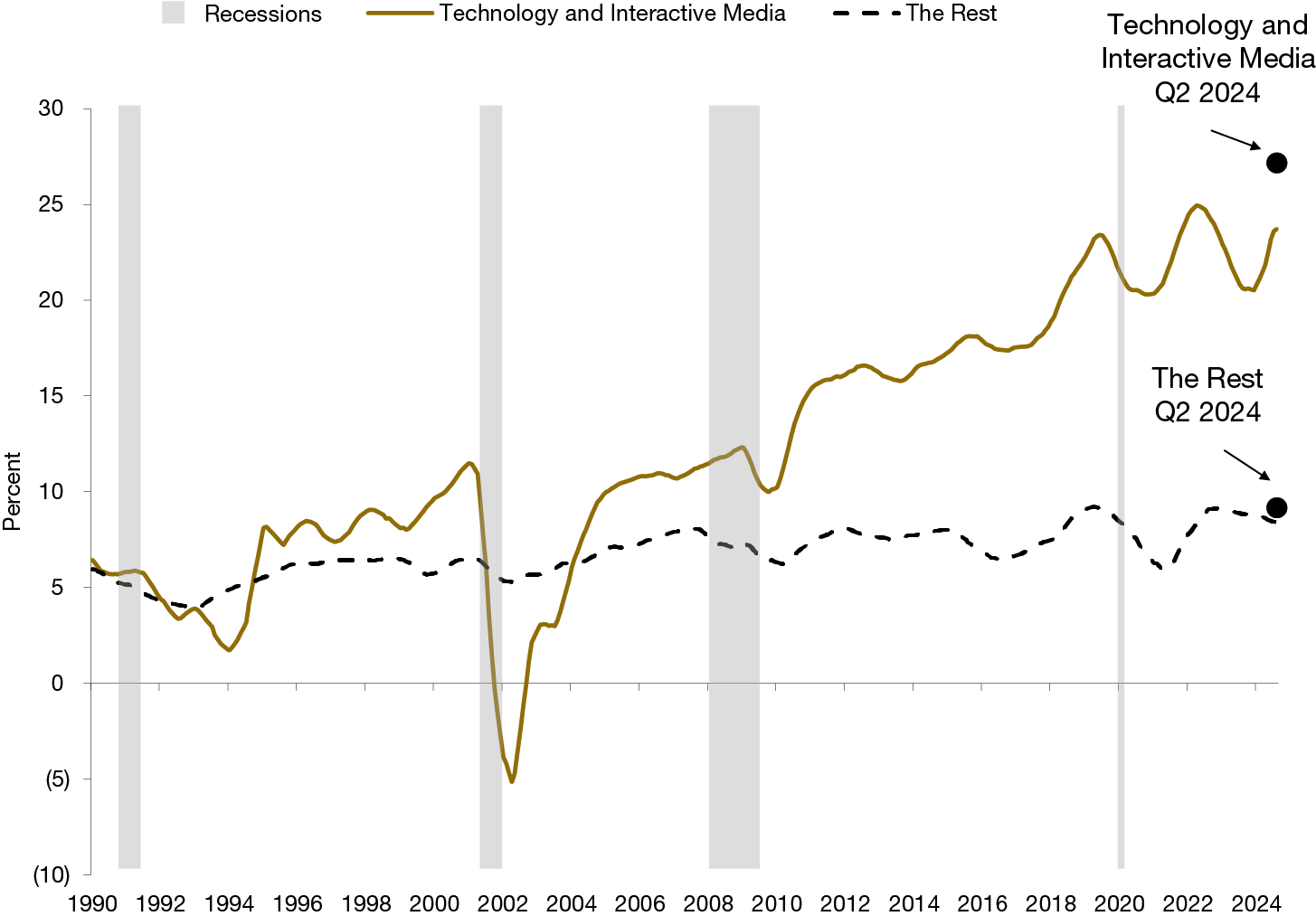
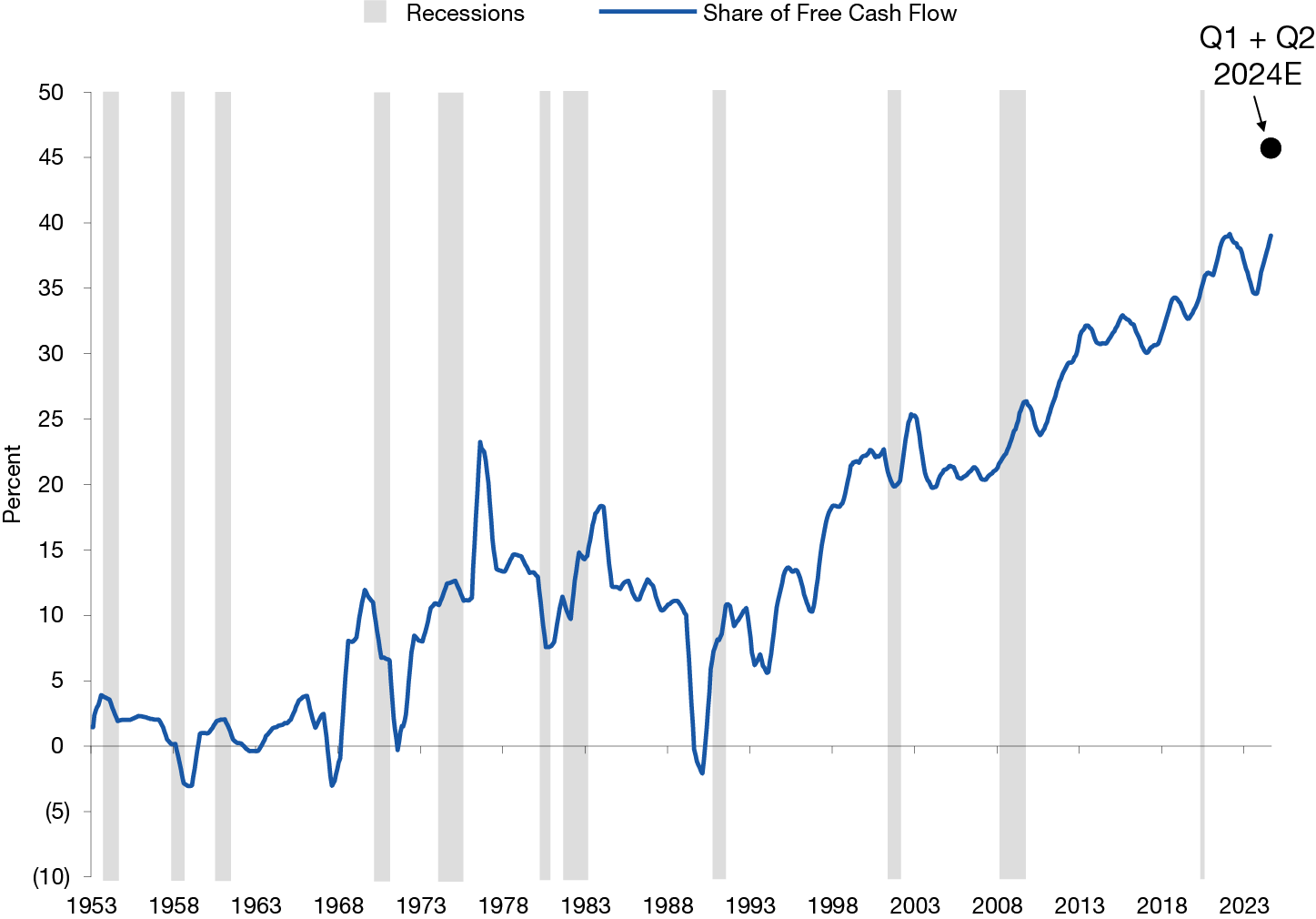
The financial impact of this disruption has been monumental. Technology and interactive media stocks now represent 45% of the S&P 500® Index’s free cash flow, which is up from 15% in the pre-internet era. The robust cash flow generation and profitability of technology companies have elevated the overall margin profile of the entire market. Today, technology stocks have achieved net profit margins nearing 30%, in stark contrast to the modest gains observed in other sectors.

Figure 3. Technology Stocks Have Had a Large Financial Impact on the Equity Market

S&P 500 stocks1 within the technology and interactive media sector—and the rest of the stocks in the index—net profit margins, December 31,1990−August 31, 2024

Figure 3a

S&P 500 stocks2 share of free cash flow coming from the technology and interactive media sector, December 31,1953−August 31, 2024

Figure 3b
Source: National Bureau of Economic Research and Empirical Research Partners. Data as of August 31, 2024. 1Based on adjusted net income measured as aggregates and data smoothed on a trailing six-month basis. Excludes financials and REITs.2 Based on trailing four-quarter data; measured as aggregates and data smoothed on a trailing six-month basis. Excludes financials and REITs. Past performance is not a reliable indicator or guarantee of future results. The historical data shown in the charts above are for illustrative purposes only and do not represent any specific portfolio managed by Lord Abbett.

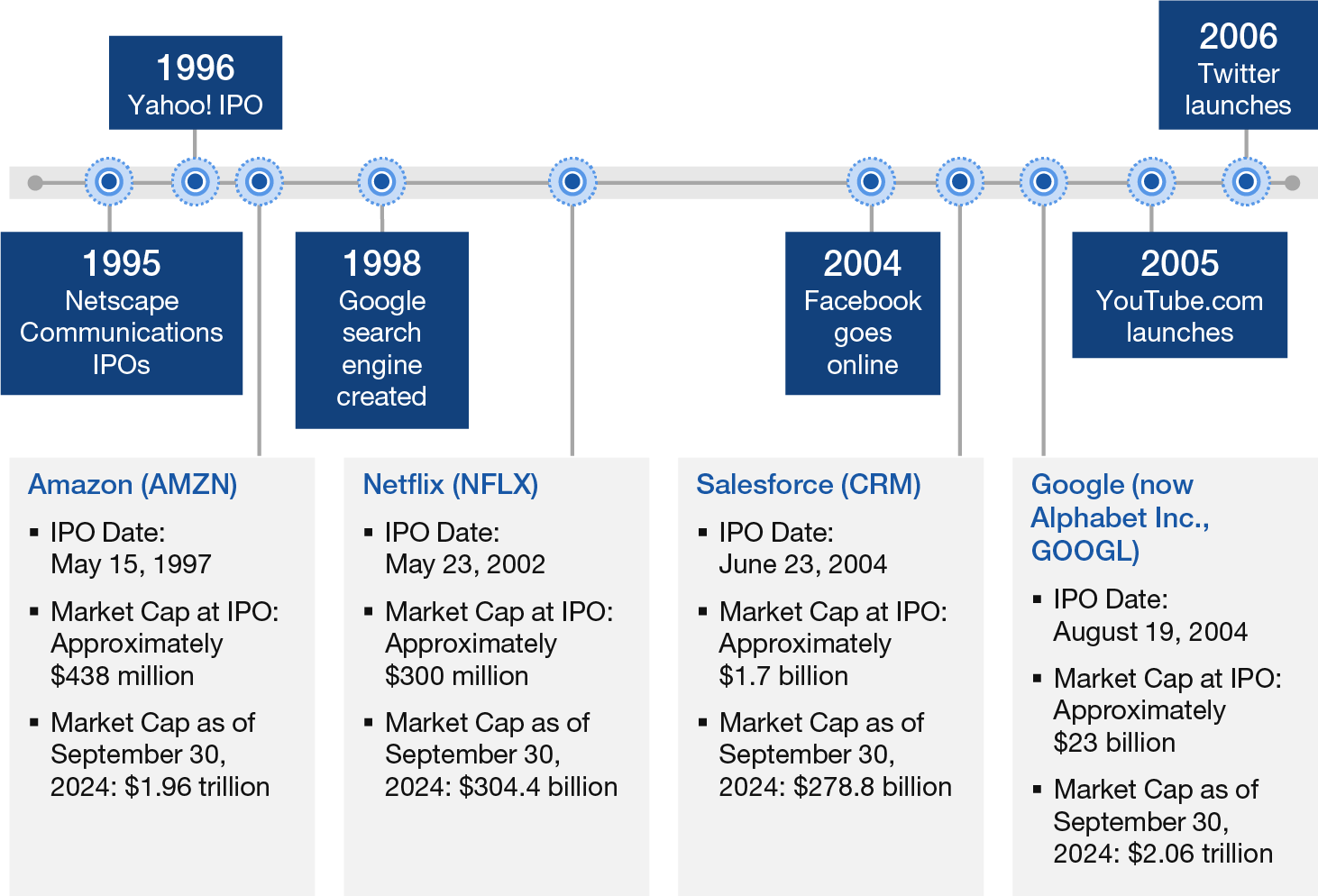
This disruptive environment fostered by the internet has given rise to new sectors, industries, and companies that have since become household names. To illustrate this, Figure 4 presents a timeline of companies that have emerged during this transformative period, many of which have become dominant players in the tech landscape today, while others serve as a cautionary tale of the volatile nature of rapidly evolving innovation.

Figure 4. Earlier Pioneers to Industry Disruptors: The Internet’s Evolution

Figure 4
Source: Morgan Stanley Research, “How Is AI Set to Change the Tech Landscape…and What’s NEXT?”, March 2, 2023. Market cap data as of September 30, 2024. IPO=initial public offering. Market cap is market capitalization and represents the total value of a publicly traded company’s outstanding shares. It is calculated by multiplying the current market price of those shares by the total number of outstanding shares. Past performance is not a reliable indicator or guarantee of future results. The historical data shown in the chart above are for illustrative purposes only and do not represent any specific portfolio managed by Lord Abbett.

Summing Up

We believe Lord Abbett equity strategies are positioned to potentially take advantage of the disruption created by AI. Historically, the market has underestimated the growth potential of emerging technologies, while some innovative companies have been disrupted by new evolving technology. We believe the unifying principle of our active approach to equity investing that seeks quality companies with durable competitive positions and capable management teams can help to identify companies positioned for AI’s transformative impact in each phase of its development. This approach spans our growth and value strategies in U.S. companies and companies outside of the U.S.