The Strategic Case for Short Duration High Yield

Seeking more from credit income while maintaining lower interest-rate sensitivity.

This is a marketing communication.

Today’s fixed-income environment offers an attractive opportunity to emphasize credit income while maintaining greater control over interest-rate risk. With income still compelling and economic growth remaining resilient, investors may not need to extend maturity to pursue attractive return potential. Short duration high yield offers a way to potentially capture the benefits of credit while limiting exposure to longer-term rate movements and duration-driven volatility.

Putting Credit to Work

The distinction between credit risk and interest-rate risk is increasingly important for fixed-income investors. To pursue additional income, investors do not necessarily need to extend maturity and take on greater exposure to longer-term rates. A shorter-duration approach helps investors to be more deliberate about where they take risk—emphasizing credit income and security selection rather than relying on duration to drive returns.

That approach can be particularly relevant when inflation, fiscal policy, economic growth, and other structural forces help to create uncertainty around longer-term interest rates. By keeping maturities shorter, investors can potentially remain invested in higher-income high yield credit markets while mitigating exposure to interest-rate sensitivity. The result is a portfolio that can be positioned more deliberately around its intended sources of return. Rather than relying on duration to drive performance, short duration high yield places greater emphasis on coupon income, credit spreads, and fundamental security selection.

Why Short Duration High Yield?

High yield has long been an important source of income and return within fixed income. At the same time, broad high yield carries greater interest-rate sensitivity than a portfolio focused on shorter-maturity securities. The question for investors is whether they can capture much of the credit opportunity without taking the full duration exposure of the broader market.

Short duration high yield can help address that trade-off. As bonds move closer to maturity, their prices generally become less responsive to changes in interest rates. Meanwhile, the relatively high income generated by the asset class provides a meaningful contribution to total return. The result is a portfolio that can rely more on income and credit selection and less on duration-driven price movements.

The combination of a shorter maturity profile and higher income can help reduce overall return volatility. Less duration-driven price sensitivity can cushion the impact of rate movements, while a larger income contribution can support total returns. Over time, this combination has produced a more attractive risk-adjusted outcome compared to longer-duration high yield, as shown in Figure 1.
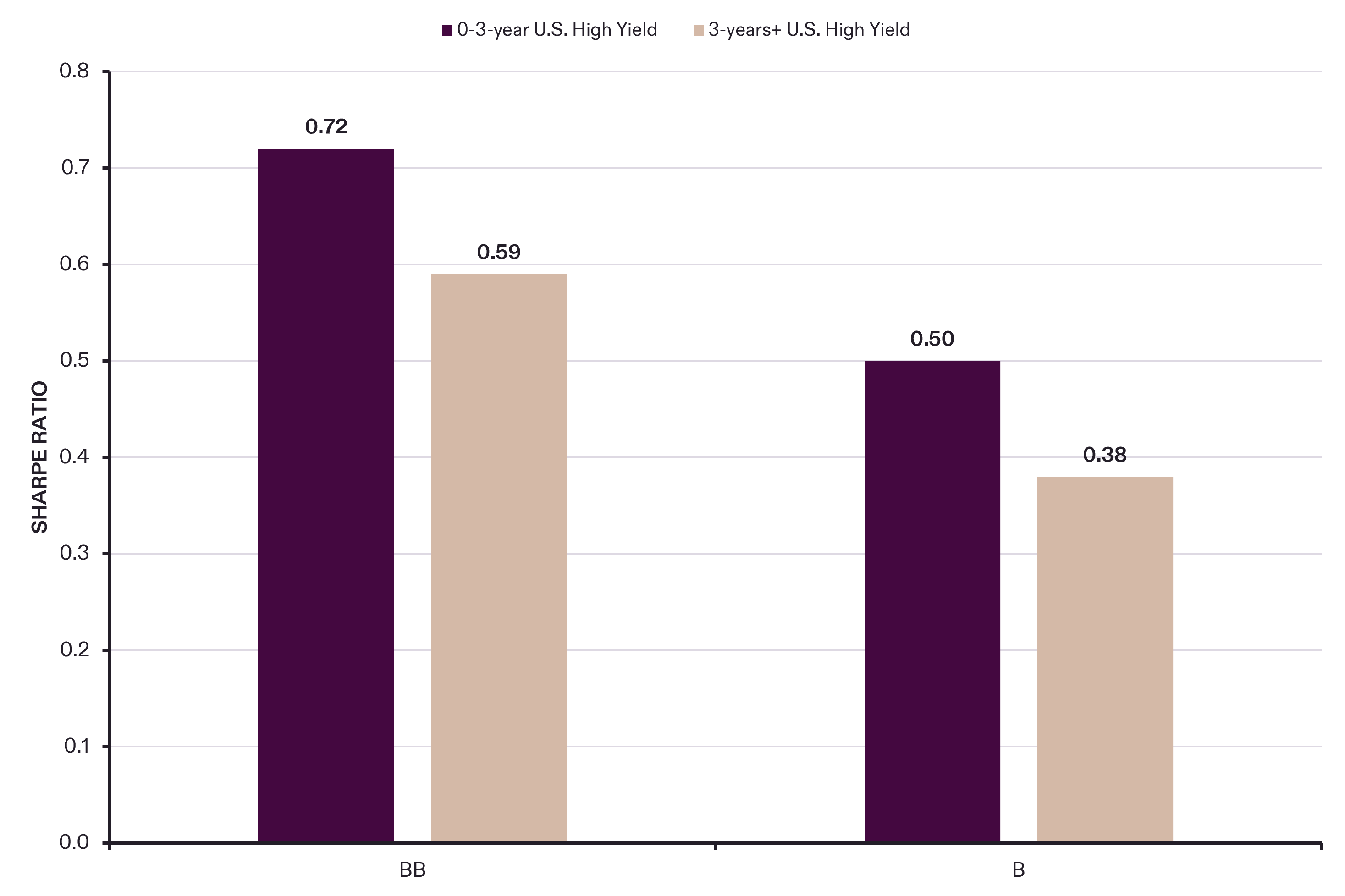
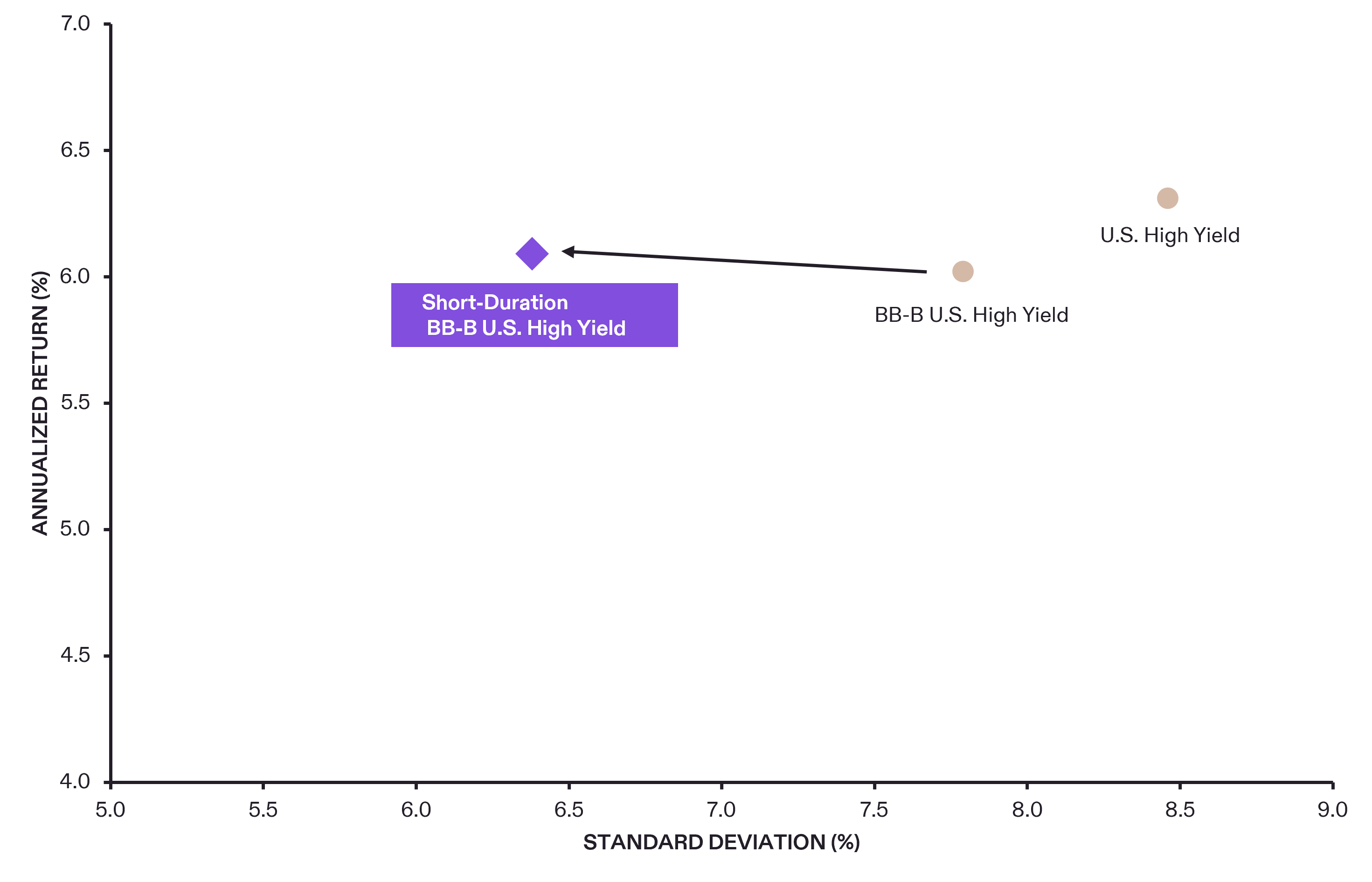
Figure 1. Short-Duration High Yield’s Historically Attractive Sharpe Ratio

U.S. high yield index Sharpe ratios by duration bucket, December 31, 1996-September 30, 2026

Bar chart comparing Sharpe ratios for BB and B rated U.S. high yield bonds across 0–3 year and 3+ year maturities, showing higher risk-adjusted returns for shorter-duration high yield bonds.

Source: Morningstar. Data as of September 30, 2026. Past performance is not a reliable indicator or guarantee of future results. The historical data shown in the chart above are for illustrative purposes only and do not represent any specific portfolio managed by Lord Abbett. Indexes are unmanaged, do not reflect the deduction of fees or expenses, and are not available for direct investment. U.S. high yield index represented by the BB-rated and B-rated segments of the ICE BofA U.S. High Yield Constrained Index. The Sharpe ratio was developed by Nobel laureate William F. Sharpe as a measure of risk-adjusted performance. It is calculated by taking an asset class’s (or portfolio’s) excess return above the risk-free rate and dividing it by the standard deviation of its returns. The greater the Sharpe ratio, the better the risk-adjusted performance has been.

A Strategic Role in Fixed Income

Short duration high yield is sometimes viewed primarily as a tactical allocation; something investors use when they seek to reduce duration exposure or wait for greater clarity on where interest rates and bond yields might be headed. We believe its role can be broader: it can serve as a potentially durable source of credit income within a diversified fixed income portfolio.

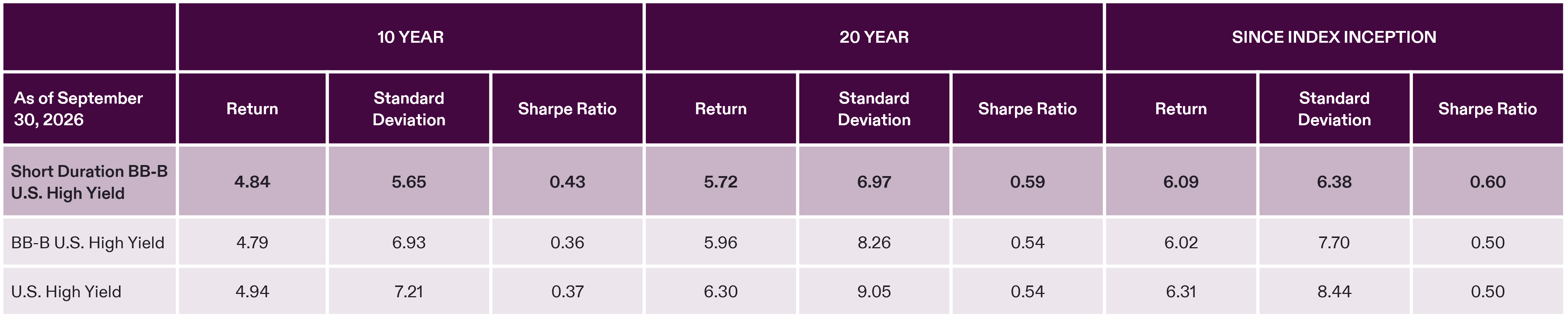
The long-term record supports this role. Since 1996, short duration BB-B high yield has generated attractive annualized returns that have been comparable to broader BB-B high yield and the overall high yield market, while exhibiting materially lower volatility, as shown in Figure 2. That combination has resulted in a stronger historical risk-adjusted profile with consistently higher Sharpe ratios across 10-year, 20-year, and since inception periods.

Figure 2. Short-Duration High Yield Provided Similar Returns to Broad High Yield or Just BB-B, With Less Volatility

Returns, standard deviation, and Sharpe ratios over the 10-year, 20-year, and since inception periods for high yield bond indices, December 31, 1996-September 30, 2026

Scatter plot comparing annualized return and standard deviation for short-duration BB-B U.S. high yield, BB-B U.S. high yield, and U.S. high yield indexes, showing short-duration BB-B U.S. high yield with similar returns and lower volatility.
Performance comparison table showing 10-year, 20-year, and since-inception returns, standard deviation, and Sharpe ratios for the Short Duration BB-B U.S. High Yield Index, BB-B U.S. High Yield Index, and U.S. High Yield Index as of September 30, 2026.

Source: Morningstar. Data as of September 30, 2026. Past performance is not a reliable indicator or guarantee of future results. The historical data shown in the chart above are for illustrative purposes only and do not represent any specific portfolio managed by Lord Abbett. Indexes are unmanaged, do not reflect the deduction of fees or expenses, and are not available for direct investment. Short-Duration BB-B U.S. High Yield represented by the ICE BofA U.S. High Yield BB-B 1-5 Year Index, BB-B High Yield represented by the ICE BofA U.S High Yield BB-B Index, and U.S. High Yield represented by the ICE BofA U.S. High Yield Constrained Index. The Sharpe ratio was developed by Nobel laureate William F. Sharpe as a measure of risk-adjusted performance. It is calculated by taking an asset class’s (or portfolio’s) excess return above the risk-free rate and dividing it by the standard deviation of its returns. The greater the Sharpe ratio, the better the risk-adjusted performance has been. 

These attractive risk-adjusted returns reinforce why a strategic allocation to short duration high yield can complement longer-duration assets and help to diversify fixed income portfolios concentrated in longer-term investment-grade bonds or government securities. In this role, it can also provide an alternative to extending farther out the yield curve in pursuit of additional yield, allowing investors to seek return through credit selection and income while maintaining a more controlled duration profile.

The Opportunity in Today’s Market

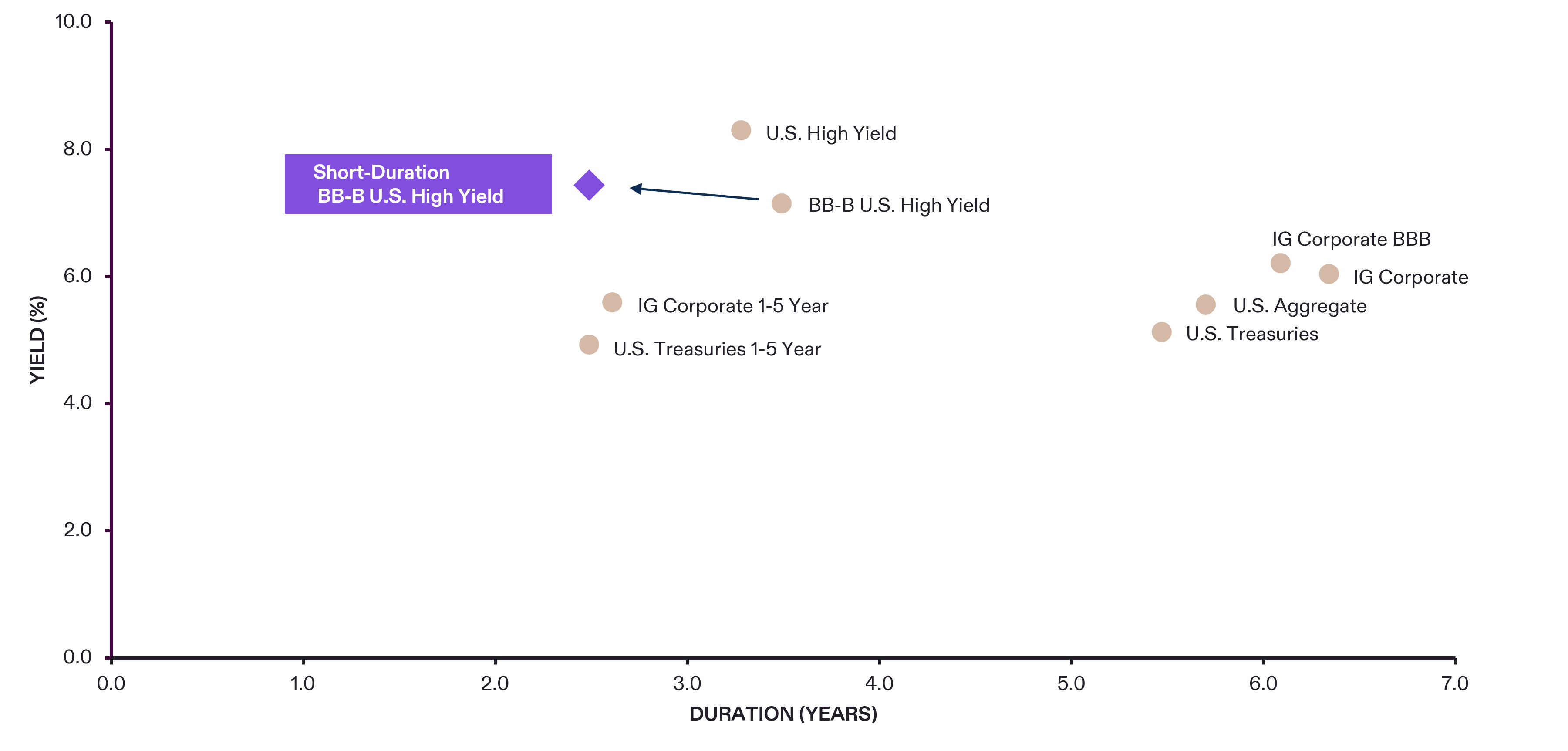
The short duration high yield market offers an attractive combination of yield and duration. As Figure 3 shows, the asset class may provide meaningfully more income than longer-duration fixed income alternatives while maintaining substantially less interest-rate sensitivity than broad high yield. For investors seeking income through credit exposure, that positioning can offer a compelling middle ground between traditional fixed income allocations and broader high yield—providing more income without taking the full duration and volatility of the broader market.

Figure 3. Short-Duration High Yield’s Attractive Income and Limited Duration Exposure

Yield and duration of indicated fixed income indices as of September 30, 2026

Scatter plot comparing yield and duration across fixed income sectors, including short-duration BB-B U.S. high yield, U.S. high yield, investment-grade corporates, U.S. Treasuries, and the U.S. Aggregate Bond Index.

Source: ICE Data Indices LLC and Bloomberg. Data as of September 30, 2026. Short-duration high yield=ICE BofA 1-5 Year U.S. High Yield Index. U.S. High Yield=ICE BofA U.S. High Yield Index. BB-B U.S. High Yield=ICE BofA BB-B U.S High Yield Index. IG Corporate 1-5 Year=Bloomberg U.S. Corporate 1-5 Year Index. U.S. Treasuries 1-5 Year=Bloomberg U.S. Treasuries 1-5 Year Index. IG Corporate BBB=Bloomberg U.S. Corporate BBB Index. IG Corporate=Bloomberg U.S. Corporate Index. U.S. Aggregate=Bloomberg U.S. Aggregate Bond Index. U.S. Treasuries=Bloomberg U.S. Treasuries Index. IG=investment grade. For illustrative purposes only and does not represent any specific portfolio managed by Lord Abbett or any particular investment. Indexes are unmanaged, do not reflect the deduction of fees or expenses, and are not available for direct investment.

Why Short Duration High Yield in an Inflationary Regime

The past five years have marked a meaningful shift from the low-inflation, low-rate environment of the prior decade toward stronger nominal growth, higher inflation, and greater interest-rate volatility. Supply disruptions, fiscal stimulus, tight labor markets, and higher commodity prices fueled a sharp inflationary episode, with U.S. inflation reaching a four-decade high of 9.1% in June 2022. While inflation has since moderated, it remains above the U.S. Federal Reserve's (Fed) 2% target, with fiscal and trade policy, geopolitical risks, and elevated capital investment potentially contributing to continued inflationary pressures and volatility in longer-term interest rates.

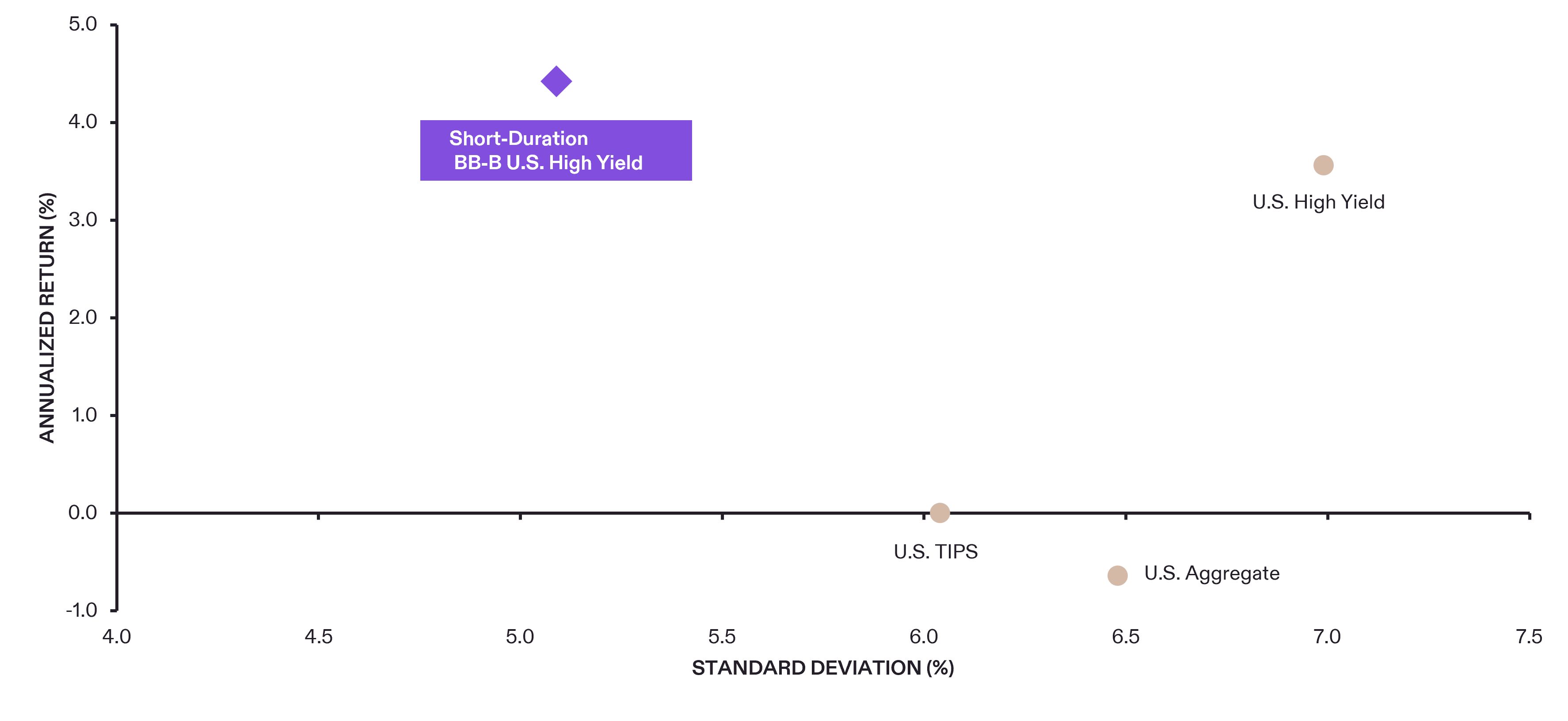
This backdrop has favored strategies that emphasize credit income while limiting duration risk (see Figure 4). Over the five years through September 30, 2026, short-duration high yield delivered higher returns than broad high yield, while also generating lower volatility and a stronger risk-adjusted return profile. Notably, the asset class also outpaced both TIPS and the Bloomberg U.S. Aggregate Bond Index over the period. While TIPS are often viewed as a natural allocation for investors seeking protection from inflation, their returns can remain challenged when real yields and broader rates rise. Short-duration high yield offers a different approach: the potential to capture elevated credit income while maintaining less sensitivity to longer-term interest rates.

Figure 4. Short Duration High Yield Performed Well in an Inflationary Environment

Trailing five-year annualized risk and returns for indicated indices, September 30, 2021–September 30, 2026

Scatter plot comparing annualized return and standard deviation for short-duration high yield, U.S. high yield, U.S. TIPS, and U.S. aggregate bonds, showing short-duration high yield with the highest return relative to its level of volatility.

Source: Bloomberg and Morningstar. Data as of September 30, 2026. Past performance is not a reliable indicator or guarantee of future results. The historical data shown in the chart above are for illustrative purposes only and do not represent any specific portfolio managed by Lord Abbett. Indexes are unmanaged, do not reflect the deduction of fees or expenses, and are not available for direct investment. Short-Duration U.S. High Yield represented by the ICE BofA U.S. High Yield 1-5 Year BB-B Index. U.S. High Yield represented by the ICE BofA U.S. High Yield Constrained Index. Treasury Inflation-Protected Securities (TIPS) are U.S. Treasury securities whose principal value adjusts with changes in inflation, as measured by the Consumer Price Index (CPI). They are designed to help investors protect purchasing power from inflation. 

We believe this environment could persist, reinforcing the strategic appeal of short duration high yield as investors seek attractive income and credit exposure without relying as heavily on falling interest rates to drive returns.

In Summary

Short duration high yield offers more than a tactical solution to interest-rate uncertainty. Its historical combination of competitive returns, lower volatility, and attractive income supports a strategic role in diversified fixed-income portfolios, allowing investors to pursue opportunities in credit while maintaining greater control over duration exposure.

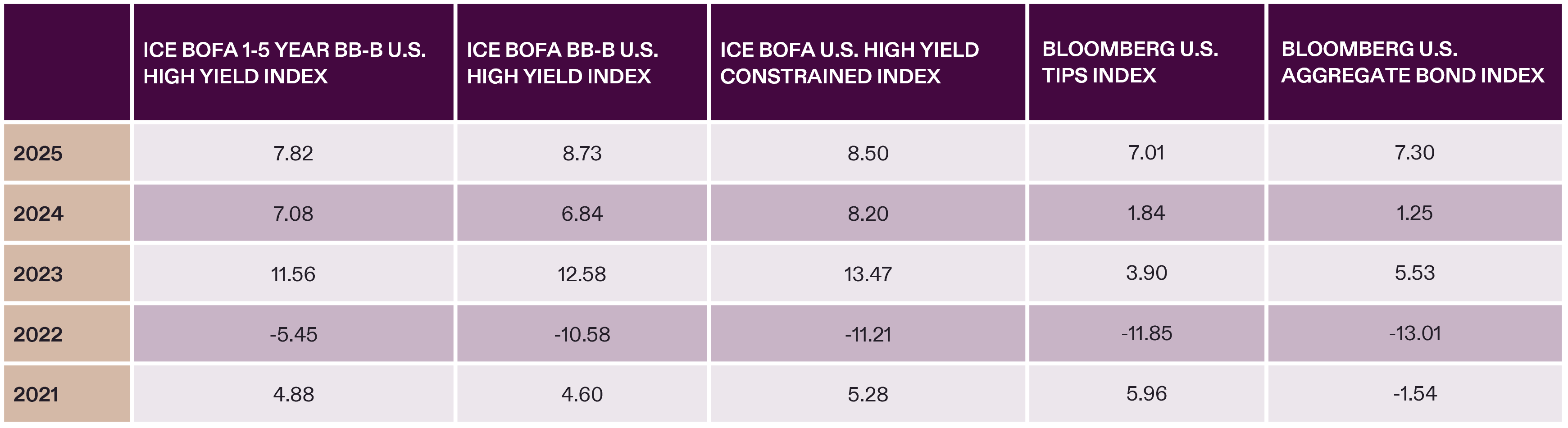
Past Performance of Selected Indices (Calendar Year):

Table comparing annual returns from 2021 through 2025 for the ICE BofA 1-5 Year BB-B U.S. High Yield Index, ICE BofA BB-B U.S. High Yield Index, ICE BofA U.S. High Yield Constrained Index, Bloomberg U.S. TIPS Index, and Bloomberg U.S. Aggregate Bond Index.

NOTE: Past performance is no indication or guarantee of future results.

Source: Bloomberg and ICE Data Indices LLC. Returns shown are expressed in percent. Return data is based on U.S. dollar-denominated index data. Performance of the indices may be affected by changes in the exchange rates between the currency denomination of the indices and any non-U.S. dollar denomination. None of the performance in this table is meant to represent any Lord Abbett products or services.